
You're usually asked for a bank certification letter at the worst possible moment. The mortgage file is ready for underwriting. The university has issued the admission letter. The visa portal shows one last missing document. Then someone emails a short request that sounds simple and turns into a problem fast: “Please provide a bank certification letter.”
Applicants often assume this is just another bank statement. It isn't. And that's why good applications stall. The bank gives a generic balance letter, the applicant uploads it, and the receiving institution rejects it because the wording is wrong, the signer is missing, the date is stale, or the document doesn't prove what the reviewer needs.
I've seen this happen in loan files, audit support packs, study permit applications, landlord screenings, and cross-border compliance reviews. The issue usually isn't that the applicant lacks funds or a real account. The issue is that the document doesn't survive verification.
The Most Important Document You Have Never Heard Of
You might be holding a purchase contract, an embassy checklist, or an admissions packet right now. Everything looks on track until one line item appears that nobody explained in advance. You need a bank-issued letter confirming your account, and you need it in a format the recipient will accept.
That's where stress sets in. Your mobile app shows your balances. Your online banking profile shows your name. You may even have downloadable statements. But the reviewer doesn't want a screenshot and doesn't want your own summary. They want a document issued by the bank.

That still matters because verification isn't always instant. TrueLayer's guidance notes that some account verification methods can take as little as a few seconds while others can take as many as 10 days, which is exactly why a bank letter still functions as a durable statement of fact in real workflows for consulates, lenders, landlords, and auditors in cases where live digital checks aren't enough, as explained in TrueLayer's overview of bank account verification.
If your request is tied to immigration or consular review, it helps to also understand how financial documents are usually assessed alongside other records. This practical guide on visa-related financial documentation is useful for seeing where the bank letter usually fits in the larger file.
A bank certification letter often feels minor until a reviewer treats it as the document that proves the rest of the application can be trusted.
The good news is that this document isn't mysterious once you know how reviewers read it. The challenge isn't getting any letter. The challenge is getting the right one.
What Is a Bank Certification Letter
A bank certification letter is a formal proof-of-account document issued by a bank. It confirms that the customer holds an account and typically includes core identifying details such as the client name, account number, and financial institution name, which Thomson Reuters describes as part of standardized verification reporting used in regulated workflows where instant checks may not be sufficient, in its guidance on bank account verification reporting.
What it is and what it is not
The cleanest way to think about it is this: the letter verifies the existence and status of the banking relationship as of a particular date.
It is not the same as a bank statement. A statement shows activity over time. A certification letter confirms facts the bank is willing to attest to on its own letterhead.
It is also not a guarantee. If you need to understand that distinction more sharply, compare it with a true assurance document such as a Rental Guarantee Letter guide, which deals with a different legal and commercial purpose. A bank certification letter proves facts. A guarantee letter can create or support an obligation.
Why the distinction matters
Reviewers reject these letters when applicants submit the wrong document type for the wrong purpose. A transaction-heavy bank statement won't satisfy a request for official bank attestation. A vague “to whom it may concern” note won't satisfy a lender that wants exact account identifiers. And a branch printout without proper bank formatting often looks unofficial, even if the information itself is accurate.
I often explain it this way to clients: a bank certification letter is like a passport for the account. It identifies the account and confirms status. It doesn't tell the full travel history.
For borrowers, the document usually supports identity, account ownership, and sometimes available funds. If your request is tied to underwriting, this overview of loan-related banking document workflows can help you frame what the lender is really trying to confirm.
The practical purpose
A useful bank certification letter usually answers a narrow question:
- Does this person or entity hold the account claimed?
- Does the account match the beneficiary or applicant details?
- If required, what balance or account type existed on the issue date?
- Can the receiving party trace this statement back to a real bank officer or branch?
If your document doesn't answer those questions plainly, it may still be genuine, but it won't be persuasive.
Anatomy of a Perfect Bank Certification Letter
A strong bank certification letter is boring in the best way. It's precise, dated, traceable, and limited to facts the bank can stand behind.
AltFunds Global's guidance gets the key principle right: the letter is a controlled verification document, not a payment guarantee, and it should confirm pre-existing facts such as account ownership, balance, account type, or banking relationship on official letterhead with an authorized bank signature, while its reliability is tied to the issue date because details like balance can change, as described in this piece on bank confirmation letter uses.
Non-negotiable elements
If any of the following is missing, acceptance risk goes up fast:
- Official bank letterhead with the institution's name clearly shown
- Date of issue so the reviewer knows when the facts were true
- Exact legal name of the account holder matching the passport, company registration, or loan file
- Account identifier details appropriate for the use case
- Statement of account status or relationship
- Authorized bank officer signature
- Printed name and title of the signer
- Bank branch or contact details if the recipient needs to verify the letter
What doesn't work well is a casual branch memo, an unsigned PDF, or a form letter that says only “customer in good standing” with no account-specific detail.
Practical rule: If a stranger at the receiving institution can't tell who issued the letter, what account it refers to, and the date the facts were true, expect follow-up questions.
What belongs in the body of the letter
The wording should stay factual. Good letters confirm things the bank already knows from its records. Bad letters drift into promises, vague endorsements, or language the bank's compliance team won't approve.
Useful content often includes:
- Account ownership in the exact legal name
- Account type such as savings or checking, where relevant
- Current balance on the issue date if proof of funds is required
- Currency if the recipient is outside your home market
- Bank identifiers needed for reconciliation or international use
- Purpose line if the recipient asked for one
A generic template can still work, but only if it aligns with the receiving institution's checklist. If you're dealing with files in mixed statement layouts or multiple export types, these common financial document formats are worth reviewing because format mismatches often create avoidable back-and-forth.
Required Information by Use Case
| Information Element | Mortgage Application | Visa/Immigration | Business Audit |
|---|---|---|---|
| Account holder legal name | Required | Required | Required |
| Bank name on official letterhead | Required | Required | Required |
| Account number | Usually required | Often required | Required |
| Account type | Often useful | Sometimes useful | Often required |
| Balance as of issue date | Often required | Commonly required | Sometimes requested |
| Currency | Useful | Important | Useful |
| Routing, IBAN, SWIFT, or similar identifier | Sometimes needed | Often needed for cross-border review | Commonly needed |
| Date of issue | Required | Required | Required |
| Authorized officer signature and title | Required | Required | Required |
| Specific purpose wording | Sometimes requested | Often critical | Sometimes requested |
What banks often omit
Banks frequently leave out the very details that trigger acceptance. The common omissions are the signer's title, the currency, the purpose of the letter, and the exact account-holder name as it appears in the receiving file.
That's why “close enough” letters don't perform well. Reviewers are trained to compare documents line by line, not by general impression.
How to Request Your Letter Step by Step
Most delays happen before the bank even starts drafting the letter. The customer asks for “a bank letter,” the branch produces its standard version, and only later does the applicant learn that the university, lender, or embassy wanted different wording.
Start with the receiver, not the bank
Before you contact your bank, collect the exact requirements from the institution asking for the letter.
Check for these points:
- Required wording. Some recipients want “proof of funds.” Others want only account verification.
- Mandatory fields. They may require account number, balance, account-opening date, currency, or branch details.
- Format rules. PDF may be fine. Some still want original paper.
- Language requirements. Cross-border files may require translation.
- Freshness requirement. Some reviewers reject documents that are no longer recent enough for their internal policy.
If you're opening or documenting banking relationships in a cross-border business context, this practical piece on UAE company banking gives a good sense of how institution-specific banking requirements can become.
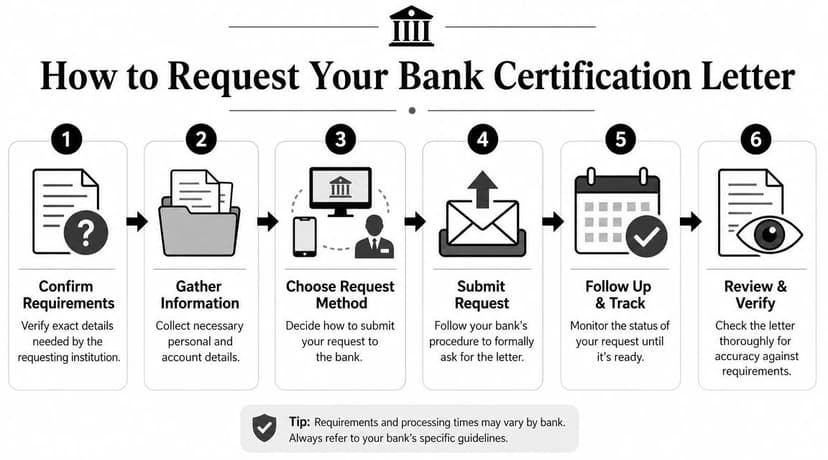
Use a request that leaves little room for improvisation
Don't ask for “a letter for my visa.” Ask for a letter with specific fields. Bank staff work faster when the request is concrete.
A practical script:
Please issue a bank certification letter on official letterhead confirming my full legal name, account number, account type, and current balance as of the date of issue. Please include the currency, date, and signature, printed name, and title of the authorized bank officer. The letter is for submission to [institution name]. If possible, please also mention that the account is maintained with your bank.
If the receiving institution provided sample wording, attach it. Don't assume the banker will infer what matters.
Choose the right channel
Different banks route these requests differently. What works best depends on the bank's own controls.
- Branch request often works best when a wet signature, stamp, or officer contact information is needed.
- Relationship manager or business banker is usually better for corporate accounts.
- Secure message through online banking creates a written record of exactly what you asked for.
- Call center request can work for simple letters, but it often produces generic output.
A short explainer can help if you want to see the request flow in a simpler format before you contact the bank.
Follow up like a reviewer would
When the bank says the letter is ready, don't submit it immediately. Review it against the original checklist.
Check these items in order:
- Names match exactly
- Account digits are correct
- Balance appears only if needed
- Currency is shown
- Date is current
- Officer signature is present
- Purpose wording matches the request
- PDF is legible and complete
A bank letter usually goes wrong in one small place, not everywhere. One mismatch is enough to trigger a rejection.
Verifying the Letter and Your Financial Data
This is the part most guides skip. Getting the letter is only half the job. The key question is what the recipient does with it.
Thomson Reuters' supplier banking guidance is useful here because it identifies the technical fields that matter most in validation. The most useful content includes the account name, bank name, account number, and routing or SWIFT details, which recipients use to reconcile the letter against other records, and it also notes that a secondary document such as a voided check or bank statement is often required because the letter verifies bank details, not ongoing transaction history, as shown in this guidance on banking support documents for supplier requirements.
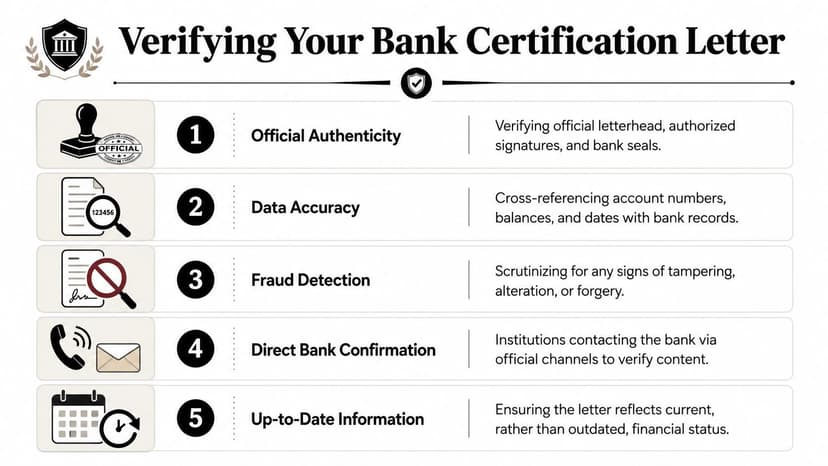
How reviewers test authenticity
A lender, auditor, or admissions office usually reads the letter with a fraud screen in mind. They don't just ask whether the document looks professional. They ask whether it can be independently confirmed.
Common verification checks include:
- Bank identity check against the institution's official presence
- Signer review to see whether the title and role appear plausible
- Field matching against application forms, prior statements, or onboarding data
- Contact verification through official channels, not just the number shown on the document
- Tampering review for altered fonts, inconsistent spacing, or incomplete metadata in PDFs
Reviewers trust letters they can trace, not letters that merely look polished.
Why a letter alone often isn't enough
A bank certification letter is a snapshot. It says, in effect, “As of this date, these facts were true.” That's useful, but limited.
If the receiving party also needs to understand account activity, source of funds, recurring deposits, or continuity of balance, they'll ask for statements. That's normal. It doesn't mean the letter failed. It means the letter answered one question and not the others.
In practice, a stronger file often includes:
- The certification letter for official account confirmation
- Recent bank statements for activity and continuity
- A secondary banking document where requested
- A simple explanatory note if there are unusual credits, transfers, or account structures
If you run into conflicting transaction totals, name mismatches, or statement formatting issues, this guide to reconciliation mismatches in financial records is useful because many “document problems” are really matching problems.
What gets letters rejected after issuance
The rejection usually comes from one of five defects:
- The letter is too generic
- The signer isn't identifiable
- The issue date is too old for the receiving policy
- The account holder name doesn't match the rest of the file
- The letter tries to do too much, such as implying a guarantee or legal assurance the bank didn't intend
Banks issue standard letters to manage their own risk. Recipients review them to manage theirs. Acceptance happens only when those two positions overlap.
Navigating International and Special Use Cases
A domestic landlord letter and an immigration proof-of-funds letter are not the same document, even when both come from the same account.
That difference catches people all the time. A local branch may happily issue a basic account confirmation, while the embassy or university expects a much more specific statement about funds, currency, and ownership.
Why international files are less forgiving
The core problem is variation. Guidance tied to Quebec immigration, for example, shows a need for a bank letter proving sufficient funds for tuition and living costs, while other templates only certify account balance or routing information. That difference matters because these documents are treated as compliance-sensitive and the rules vary by destination and institution, as reflected in this bank letter template tied to school and immigration-related use.
What works for one country may fail in another because the reviewer is not merely checking whether you have a bank account. They're checking whether the document satisfies a specific legal or administrative standard.
Issues that commonly change across borders
International use cases often turn on details applicants overlook:
- Currency presentation. The amount may need to appear in the account currency exactly as held.
- Translation. Some institutions accept the original plus translation. Others have formal translation rules.
- Joint accounts. One country may accept them with explanation. Another may require evidence of access rights.
- Signature format. A digitally issued PDF may be accepted in one setting and challenged in another.
- Purpose wording. “Account verification” may not satisfy a request for “proof of funds.”
If you're setting up a commercial presence abroad, banking paperwork often intersects with larger formation decisions. This guide to starting a business in Australia as a foreigner is a useful example of how banking evidence and legal setup can affect each other in practice.
What actually works in special cases
For international and institutional submissions, don't rely on your bank's standard wording unless the receiving body has already approved it.
Use this approach instead:
- Get the exact checklist from the recipient
- Ask whether a template or sample is available
- Confirm whether translation, notarization, or certification is needed
- Match names across passport, school file, company records, and bank account
- Keep the issue date close to the submission date
If your supporting statements are in another language, this resource on working with foreign-language bank statements can help you think through what needs to be standardized before submission.
The biggest mistake in international files is assuming “official” means “acceptable everywhere.” It doesn't.
Frequently Asked Questions
How much does a bank certification letter cost?
Banks handle this differently. Some issue it as a routine customer service document. Others treat it as a special request. Ask before the letter is prepared, especially if you need multiple originals or an expedited branch process.
Can a digitally signed or emailed PDF be accepted?
Often yes, but only if the receiving institution allows it. The main issue isn't convenience. It's whether the reviewer can verify authenticity under their own document policy. For some files, a branch-stamped paper original still causes less friction.
How long does it take to get one?
There's no universal timeline. Some banks can issue standard verification quickly. Others route the request through branch management or back-office operations. The fastest way to avoid delay is to send the exact required wording up front and confirm the delivery format at the start.
Can I speed it up?
You can improve your odds by being specific. Give the bank a short written request, attach the recipient's checklist, and ask the branch to confirm whether an appointment or officer signature is required. If the matter is urgent, ask whether the bank can issue a provisional PDF first and the original after.
What if my bank refuses to include the details I need?
That happens often with balances, account-opening dates, or customized language. If the bank won't include a field, ask the receiving institution whether they'll accept a secondary document to cover that point. Many will accept a bank statement, voided check, or separate confirmation if the package as a whole answers the verification question.
Is a bank statement a substitute?
Sometimes, but only if the recipient says so. A statement shows activity. A bank certification letter shows formal bank attestation. They solve different problems.
What is the most common reason these letters fail?
Mismatch. The name differs from the passport. The letter is dated too early. The account number is partial when the reviewer expected full digits. Or the bank used generic wording that doesn't meet the exact purpose of the request.
If you need to support a bank certification letter with organized transaction history, ConvertBankToExcel helps turn bank statements into clean Excel and CSV files that are easier to review, reconcile, and share with accountants, lenders, and compliance teams.