
![Bank Statement for Visa Application: What Embassies Need [2026]](/_next/image?url=https%3A%2F%2Fconvertbanktoexcel.com%2Fapi%2Fuploads%2Fimages%2Fprofessional-reviewing-bank-statement-documents-for-visa-application-at-embassy-1776452688522.jpg&w=1920&q=75)
Bank Statement for Visa Application: What Embassies Really Need [2026]
Your visa got denied because of a bank statement. Not the finances inside it — the format, the date range, or a detail the officer couldn't verify. I've watched this happen to well-funded applicants who submitted the wrong document.
This guide covers exactly what consulates require, by visa type. It also covers how to organize your statements before submission so nothing gets missed.
Why Consulates Ask for Bank Statements
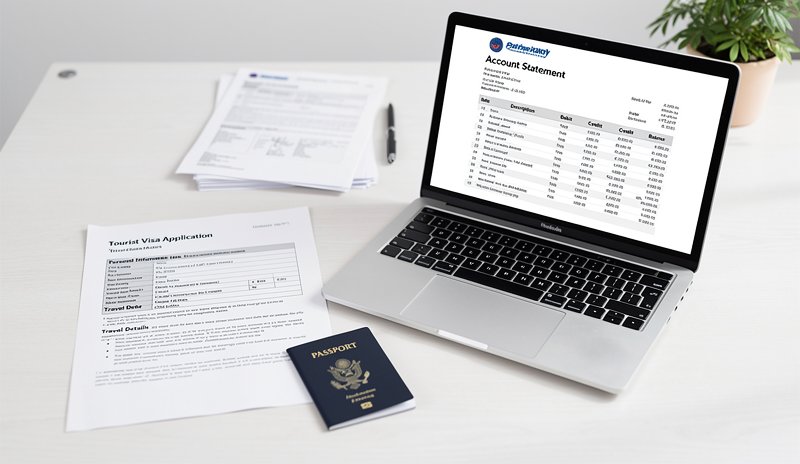
The bank statement tells the officer one thing: can this person financially support themselves during the visit, and are they likely to return home? Insufficient funds are one reason for denial. But here are the other reasons that catch people off guard:
- Statement covers the wrong date range
- Balance appears inconsistent (big deposits right before the application)
- Statement lacks a bank header or official stamp
- Funds are held in a joint account but the primary holder isn't the applicant
- Transactions are in a foreign currency with no conversion note
Understanding what officers look for lets you prepare a clean package. The details below differ by visa category.
Requirements by Visa Type
Tourist Visa (Schengen, UK, US B-2, Canada)
Tourist visa requirements are the most standardized globally.
How many months: 3–6 months is standard. The Schengen area officially asks for 3 months, but individual embassies (France, Germany) regularly request 6. The UK Visitor Visa asks for 6 months. For the US B-2, there's no fixed rule, but 3–6 months covering recent activity is the norm.
Format accepted: PDF from your bank's online portal, printed and signed by a bank officer, or both. Some embassies (notably UK) now accept digital statements without stamps. Most Schengen embassies still require an official stamp or letterhead from the bank.
Minimum balance: No universal number — this is the most misunderstood part. The Schengen rough guideline is €50–€100 per day for the duration of stay. A 14-day trip to France with no accommodation pre-booked might require €1,400 demonstrated over 6 months. Pre-booked hotels reduce the threshold.
Common mistake: Depositing a large lump sum a week before applying. Officers note sudden spikes. Consistent income flowing through the account over 3–6 months reads far better than a single €5,000 transfer.
Student Visa (F-1 USA, Tier 4 UK, German Student Visa)
Student visa financial requirements are more specific because they're tied to tuition and living costs.
How many months: 6 months of statements, usually. Some US F-1 cases only require current balance and a letter, but the consulate's DS-160 supporting documents still call for financial evidence.
Minimum balance: Must cover tuition plus 12 months of living costs. For a US university charging $30,000/year in tuition plus $15,000 in living costs, the bank statement needs to show $45,000 accessible — or a combination of statements from the student and sponsor (parent).
Sponsor statements: If a parent is funding the student, you need both the student's statement and the sponsor's statement, plus a notarized support letter. Both documents go through the same format requirements.
Format requirements: Same as tourist — official letterhead, dated within 30–90 days of application, account holder name must match the applicant's passport name exactly.
Work Visa (H-1B USA, Skilled Worker UK, German Work Permit)
Work visas shift the burden slightly — the employer's offer letter does most of the financial heavy lifting. But bank statements still matter.
When required: Most work visa categories require proof of existing funds to cover relocation or the waiting period before first paycheck. The German work permit requires 12 months of proof that you can support yourself during the approval period.
Format: 3–6 months, standard bank format. No unusual requirements beyond the basics.
Schengen Visa (Specifically)
Schengen deserves its own section because the 26-country area has specific requirements that the individual country embassies interpret differently.
Official Schengen guidance: 3 months of recent statements. The balance should reflect your stated travel budget.
France (most strict): Often requests 6 months, requires stamped paper statements from the branch, may reject online-generated PDFs without a wet stamp.
Germany (moderately strict): Accepts PDF statements but requires the bank's header and account number visible on every page.
Netherlands (more lenient): Accepts online PDFs in most cases, 3 months standard.
Key principle: When in doubt, submit more — 6 months, official stamp, cover letter. Over-documenting costs nothing. Under-documenting costs the visa.
Format Requirements: What Officers Actually Check
Regardless of visa type, the document itself must meet these criteria:
- Bank letterhead visible — every page must show the bank's name and logo
- Account holder name — must match your passport exactly (middle names matter)
- Account number — fully visible, not partially redacted
- Date range clearly shown — start and end date of the statement period
- Running balance — each transaction should show the balance after it
- Bank's official stamp — required by many embassies; an online PDF without it may not be accepted
- Issued within 30–90 days — stale statements (older than 3 months from issue date) are commonly rejected
- Language — some embassies require translation into English or the destination country's language, notarized
PDF vs. printed: Online PDFs are increasingly accepted, but always check the specific consulate's current requirements. The UK Home Office accepts digital. Most Schengen posts vary by country.
How to Organize Your Statements Before Submission
This is where most applications get sloppy. You've printed 6 months of statements — now what?
Step 1: Verify account holder name matches passport. Pull out your passport. Check every word. If your bank statement says "John M. Smith" and your passport says "John Michael Smith," call your bank to get an updated statement before applying.
Step 2: Check the date range. For a 6-month requirement, today is April 2026 — your statements should cover October 2025 through March 2026. Make sure there are no gaps between statement periods.
Step 3: Check for large unexplained deposits. Review your own statements from the officer's perspective. A €4,000 deposit in January with no recurring income pattern will raise questions. Prepare a cover letter explaining any large transfers.
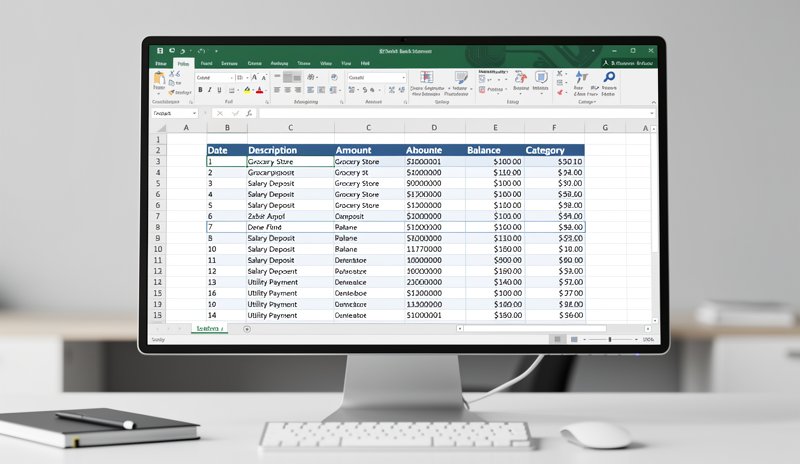
Step 4: Convert to a reviewable format. This is the step most people skip. Converting your bank statement PDF to Excel lets you verify:
- Total running balance at end of each month
- Income vs. expenses ratio
- No duplicate transactions
- Correct totals before you submit
Try it free at convertbanktoexcel.com — paste your PDF in, get a clean Excel sheet in under 60 seconds.
Step 5: Calculate your daily balance. Divide your end-of-period balance by the number of travel days requested. For Schengen, multiply by the days staying. If the number looks tight, you'll know before the officer does.
Step 6: Organize the physical package. Chronological order, oldest on the bottom. A cover page listing "Bank Statements: [Month] through [Month]" helps the officer find them immediately.
How ConvertBankToExcel.com Helps
The format conversion step exists because bank PDFs are not designed for review — they're designed for printing. Lines run together, columns shift between statement periods, and page breaks cut transactions in half.
ConvertBankToExcel.com converts your bank statement PDF into a structured Excel or CSV file:
- Every transaction on its own row
- Dates, descriptions, debits, credits, and balance in separate columns
- Consistent format regardless of which bank generated the original
This matters for visa applications specifically because:
Pre-submission review: You catch formatting inconsistencies in your own records before the officer does. Missing months, duplicate transactions, unexplained gaps — these become visible in a spreadsheet in seconds.
Balance verification: Excel lets you use SUM formulas to verify your stated balance matches the running total. Officers sometimes do this manually. If the numbers don't add up on your statement, that's a red flag you can correct.
Translation support: If you need to provide a translated version of your statements, starting from a clean Excel file is far easier than re-typing from a PDF.
Accountant or immigration consultant review: If you're working with a consultant, sending them a clean Excel file rather than 18 pages of PDF saves time and reduces errors.
For free methods to convert your statements, see bank statement to CSV free methods. For a comparison of converter tools, see bank statement to Excel converter options.
Common Rejection Reasons Related to Bank Statements
Based on patterns from visa refusal notices, these are the specific bank statement issues that trigger rejections:
1. Statement too old. An issue date from 4 months ago doesn't show current financial standing. Always request fresh statements within 30 days of applying.
2. Balance too low for stated travel duration. A 3-week Schengen trip with €800 in the account signals financial risk. The threshold isn't published, but the officer makes a judgment based on cost of living.
3. Name mismatch. "John Smith" vs "John A. Smith" — officers are trained to flag these. Get a statement with the exact name on your passport.
4. Missing pages. A 6-month statement requirement means every page of every month. If page 3 of your March statement is missing, the package is incomplete.
5. No letterhead. Screenshots of mobile banking apps are not accepted. The document must come from the bank's official statement generation system.
6. Large suspicious deposit. Transferring money from a family member right before applying to inflate the balance is flagged as inconsistent with your income pattern. If you've received legitimate funds, include supporting documentation.
7. Inconsistent income. Irregular deposits with no clear source look risky. Freelancers and self-employed applicants should include tax returns and contracts alongside the statement.
For general immigration documentation requirements beyond visa applications, see bank statement for immigration: requirements and format.
Frequently Asked Questions
How many months of bank statements for a visa application?
3–6 months is the standard range. Tourist visas (Schengen, UK) typically require 3–6 months. Student visas usually require 6 months. Always check the specific consulate's current requirements before applying — rules change and embassies have discretion.
Does the bank statement need to be stamped for a visa?
It depends on the consulate. France and most Schengen embassies require an official bank stamp on paper statements. The UK Home Office accepts online-generated PDFs without stamps. US visa applications accept bank-issued statements without a separate stamp. When in doubt, get the stamp — it takes 10 minutes at a branch.
Can I use a joint account bank statement for a visa?
Yes, but you'll need a letter from the primary account holder confirming you have access to the funds. Some embassies also ask for the co-holder's identification. Your name must appear on the statement.
What if my bank statement is in a foreign language?
Most embassies require translation into English or the local language. The translation must be notarized or certified by an accredited translator. A converted Excel file of your transactions is not a substitute for an official translated statement — but it can help your translator work faster.
Is a 3-month bank statement enough for a Schengen visa?
Technically yes — 3 months is the official guideline. But embassies in France, Germany, and Spain often request 6 months in practice. Submitting 6 months is never penalized. Submitting 3 when they want 6 causes delays or denial.
What balance do I need on my bank statement for a tourist visa?
There's no single number. Schengen uses an informal guideline of €50–€100 per day. For a 10-day trip, that's €500–€1,000 minimum above your other financial commitments. The UK uses a broader "sufficient funds" standard assessed against accommodation, tickets, and trip duration. Having 2–3x the estimated trip cost demonstrably available throughout the statement period is safer than a one-time balance spike.
Can I convert my bank statement PDF to Excel to help with my visa application?
Yes — and it's a useful step before submission. Converting to Excel lets you verify totals, check date continuity, and catch any discrepancies before the officer does. Try the free converter at convertbanktoexcel.com to get a clean, reviewable spreadsheet from your bank's PDF in under a minute.
Prepare Once, Submit with Confidence
The bank statement part of a visa application fails for preventable reasons — wrong date range, missing stamp, name mismatch, inconsistent balance. None of these require more money. They require preparation.
The checklist is short:
- 3–6 months of statements, fresh within 30–90 days
- Official bank letterhead on every page
- Account holder name matching your passport exactly
- Running balance shown per transaction
- Stamp from branch if the consulate requires it
Convert your bank statement to Excel before you review it — the structured format catches issues that are invisible in a PDF. It takes 60 seconds and may prevent a rejection that takes 3 months to reapply from.
Start your free conversion at convertbanktoexcel.com.