
A lot of people only learn what a certified bank statement is when something important is already on the line. A visa file gets flagged. A lender asks for “certified funds evidence.” A lawyer rejects a printout you downloaded from online banking. At that point, the issue isn’t whether the statement is accurate in everyday terms. The issue is whether the receiving institution will treat it as reliable enough to make a decision.
That distinction matters more than most applicants expect. In routine situations, a regular PDF statement is fine. In legal, lending, immigration, and audit settings, it often isn’t. The difference comes down to authentication, format, and whether the bank has formally stood behind the document.
I’m writing this from the practical side of the desk. When these documents work, they move files forward quickly. When they don’t, the problem is rarely the balance itself. It’s usually a missing stamp, an outdated issue date, an incomplete page set, or a recipient who asked for certification and received a standard statement instead.
Why a Regular Bank Statement Isn't Enough
A common failure point looks like this. Someone submits a clean online banking PDF for a mortgage pre-approval or visa application, assuming the transaction history speaks for itself. A few days later, the file comes back with a request for a certified bank statement or a bank letter confirming the same information.
That happens because a regular statement is just a record. A certified one is a record the bank has authenticated. In high-stakes review, that difference is decisive. The institution receiving it isn't only asking what your account shows. It's asking whether the document can be trusted as untampered proof of funds.
For lenders, immigration officers, auditors, and courts, the risk is obvious. A self-downloaded file can be edited, partially printed, or stripped of context. A certified version carries the bank’s stamp or signature and is presented as official proof. That gives the reviewer something they can rely on when they need more than convenience.
Where applicants get tripped up
The mistake usually isn’t dishonesty. It’s imprecision. People hear “bank statement” and assume any statement will do.
What matters is the request language. If the file asks for certified proof, then a plain download is the wrong document, even if every transaction on it is genuine. The same issue comes up in lending, where applicants often prepare income records and asset summaries but overlook the need for stronger document authentication. If you're organizing funds evidence for a home loan, this mortgage statement preparation guide helps clarify what lenders typically expect alongside account records.
The fastest way to delay an application is to submit the right information in the wrong document form.
Decoding the Certified Bank Statement
A regular bank statement is like a photocopy of an ID. It may be accurate, but standing alone, it doesn’t prove much about authenticity. A certified bank statement is closer to presenting that ID in person while an authorized official confirms it’s genuine.
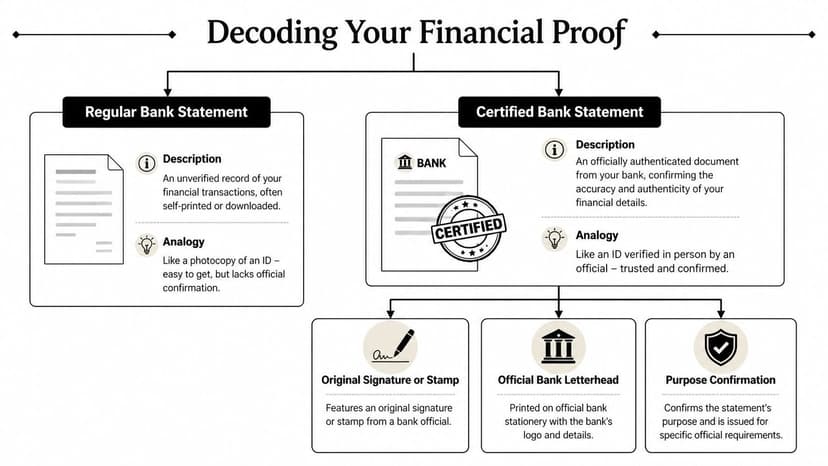
That official confirmation is what changes the document’s legal and practical value. According to DocuClipper’s overview of certified bank statements, certified statements are bank-verified documents used to confirm accuracy and prevent tampering. They’re typically required to be dated within the last 90 days, printed on official bank stationery, and include the bank’s name or logo, the account holder’s name, the account number, and an official signature or stamp on every page.
What makes it certified
In practice, reviewers usually look for a specific set of elements:
- Official bank branding. The statement should appear on the bank’s stationery or formal document format, not as an unmarked spreadsheet or cropped screenshot.
- Full account identification. The account holder’s name and account number need to be visible and consistent with the application.
- Recent issuance. Freshness matters. A statement that is technically accurate but too old may still fail.
- Bank authentication on the pages. This usually means a stamp, seal, or signature from an authorized bank officer.
- No visible alteration. Handwritten edits, mismatched fonts, missing pages, or signs of manipulation usually undermine the document immediately.
Why those details matter
These requirements aren’t decorative. They exist to solve a fraud problem. If a bank applies its official certification, the receiving party can treat the document as third-party verified rather than applicant-produced.
That’s especially important when a reviewer is checking source of funds, continuity of balances, or consistency with other records. In audit settings, certified statements help cross-check transactions against books and confirm balances as neutral external evidence. Their structure also makes transaction dates, amounts, and running balances easier to review systematically.
For accounting teams that need to work with statement data after collection, a bank statement parser workflow can help bridge the gap between document review and usable transaction records.
| Document type | What it proves | Typical weakness |
|---|---|---|
| Regular statement | Account activity as displayed or downloaded | May not satisfy authenticity requirements |
| Certified bank statement | Account activity authenticated by the bank | Harder to obtain, but far more usable for formal review |
Key Use Cases for Certified Bank Statements
A certified bank statement usually appears when the party reviewing your file has to make a consequential decision and can’t rely on self-prepared evidence. The more serious the decision, the more likely they are to insist on bank-authenticated proof.
Visa and immigration files
Visa applications are one of the clearest examples. The government isn’t just checking whether you have an account. It’s assessing whether you can support yourself or meet sponsorship requirements using real, documentable funds.
For that reason, statements often need to be recent and formally authenticated. If you’re assembling this type of file, a focused bank statement for visa guidance page can help you organize the evidence correctly before submission.
A practical point here is that visa officers often review formatting as closely as balances. If pages are incomplete, unreadable, or inconsistent, the application can stall even when the underlying finances are solid.
Mortgage and loan underwriting
Lenders use certified statements to reduce a different risk. They want to know that down payment funds, reserves, and account activity are genuine and not temporarily staged for underwriting. A standard statement may show the money. A certified one gives the lender stronger assurance that the record wasn’t manipulated before submission.
For borrowers juggling pay stubs, tax records, asset statements, and banking proof, this guide to mortgage paperwork is a useful checklist because it places certified financial records in the broader loan file, where omissions often happen.
Legal proceedings and settlements
Courts and counsel often need a document that can hold up under scrutiny from the other side. In divorce matters, civil disputes, probate, and support proceedings, a certified bank statement can carry more weight than a downloaded PDF because it comes with external authentication from the financial institution.
That doesn’t guarantee acceptance in every forum. It does make the document harder to challenge on authenticity grounds. When records may become exhibits or support sworn filings, that matters.
Audits and professional reviews
Businesses run into this requirement during financial reviews and audits. Certified statements help auditors compare bank activity against internal books, confirm balances, review transaction history, and identify discrepancies. Banking literature cited in the same DocuClipper article referenced earlier notes a case in which requiring a certified financial statement helped a bank avoid $40,000 in potential losses.
A certified statement doesn’t prove every conclusion in a file. It proves the bank stands behind the document itself. That’s often the threshold the reviewer needs before they assess anything else.
Your Step-by-Step Guide to Getting a Certified Statement
Banks don’t all use the same language. One branch may call it a certified statement. Another may offer a stamped statement, a bank verification letter, or a manually signed transaction printout. The job is the same. You need the bank to issue an official document that the recipient will accept.
Start with the exact requirement
Before you contact the bank, read the request from the recipient carefully. You need to know:
- Which account is being documented.
- What date range is required.
- Whether every page must be stamped or signed.
- Whether a bank letter is acceptable instead of a statement.
- Whether translation or currency notation is required.
If the requesting party gave you written instructions, bring them to the branch or attach them to your secure message to the bank.
Ask the bank in operational terms
Front-line staff sometimes don’t recognize the phrase “certified bank statement,” even though the bank can produce what you need. Ask for one of the following, depending on the situation:
- A stamped statement for the required period
- A statement signed by an authorized bank officer
- A bank letter certifying the statement or confirming the balance
- Official branch authentication on each page
Pro tip: If the teller looks unsure, don’t argue over terminology. Say, “I need an official statement for a legal or immigration file, stamped or signed by the bank so the recipient can verify it was issued by the bank.”
That phrasing usually gets you to the right person faster than repeating the label.
Check the age and completeness before you leave
For U.S. visa sponsorship matters, ConvertBankStatement.io notes that USCIS often requires statements less than 90 days old and stamped and signed by a bank official. The same source says non-compliance is a leading cause of rejections, with some estimates suggesting it contributes to 30-50% of denials due to document fraud concerns.
That means you should inspect the packet immediately. Don’t assume the branch produced it correctly.
Use this checklist:
- Review the issue date. If the statement is stale by the time you submit, it may fail.
- Confirm every page is present. Missing continuation pages create obvious problems.
- Look for the stamp or signature where required. One authenticated cover page may not be enough.
- Match names and account details. Any mismatch with the application can trigger extra review.
- Inspect readability. If balances, account numbers, or transaction lines are blurry, ask for a fresh print.
If the bank pushes back
Some banks are cautious about adding signatures to statements. Others will only issue a separate letter. In that situation, ask the recipient whether a bank letter on official letterhead confirming account ownership, opening date, and current or recent balance will satisfy the requirement. In the U.K., that type of bank letter is commonly part of the certification process.
If you need to submit documents electronically after collection, this complete guide to bank statement conversion is useful for understanding how to preserve document quality and avoid introducing formatting issues during upload.
How recipients spot weak or fake submissions
From the reviewer’s side, the warning signs are predictable:
| Red flag | Why it causes trouble |
|---|---|
| Missing stamp on some pages | Suggests incomplete authentication |
| Cropped or partial images | Prevents full review of the document |
| Inconsistent fonts or overlays | Raises alteration concerns |
| Illegible transaction lines | Stops verification of activity and balances |
| Old issue date | Makes the proof stale for formal review |
Navigating International Statements and Avoiding Rejection
A certified statement from one country doesn’t automatically work in another. That assumption causes more problems than people expect. Cross-border use adds at least three separate questions. Is the statement authenticated? Is it readable to the recipient? Is it legally usable in the destination process?
Certification is only the first layer
If the statement is in another language, certification alone may not solve the problem. Many recipients need a certified translation, especially where the document supports immigration, lending, or court filings. A reviewer can’t verify funds from a document they can’t read confidently.
Formatting is another issue. Foreign statements often use different date order, transaction labels, decimal conventions, and account identifiers. According to Universal Translation Services, an estimated 15% of U.S. visa applicants, or over 1 million cases annually, face delays or rejections due to unreadable or improperly formatted foreign financial statements.
That number tracks with what practitioners see in real files. The problem often isn’t fraud. It’s poor usability.
What usually goes wrong
The most common rejection triggers are procedural, not financial:
- Unreadable scans. A low-quality image can make a valid statement unusable.
- Missing translation support. The bank document may be genuine, but the reviewer still can’t evaluate it.
- Currency not clarified. Some recipients want amounts translated into a reference currency for review.
- Incomplete certification. One page is stamped, the rest are not.
- Wrong signatory. The document is signed, but not by someone the bank authorizes for certification.
- Local validity misunderstood. A document accepted in one jurisdiction may need further legalization elsewhere.
When Apostille and local advice matter
For some international legal uses, an Apostille or similar legalization step may be necessary. That doesn’t apply to every visa or loan file, and applicants shouldn’t guess. The receiving authority or counsel should tell you whether the bank document itself, the translation, or an accompanying affidavit must be legalized for cross-border acceptance.
This becomes especially relevant in international property transactions. If you're dealing with cross-border financing structures, co-borrowing for expatriates buying in France is a useful example of how document expectations can shift once a file moves into another legal and lending system.
For teams handling non-English statements operationally, foreign language statement processing workflows can help prepare readable, structured records without losing the original document trail.
A foreign certified statement fails most often because the recipient can’t process it cleanly, not because the account holder lacks funds.
From Certified PDF to Clean Data for Accountants
Certified statements solve an authenticity problem. They don’t solve a bookkeeping problem. For accountants, that’s the main trade-off.
The documents that work best for lenders, visa officers, and lawyers often arrive in the least convenient format for accounting teams. They’re scanned PDFs, branch-stamped copies, low-contrast exports, or photo-based uploads from clients who used a mobile app at the last minute. A human can read them. That doesn’t make them efficient to post, reconcile, or import.
Why manual entry breaks down
A certified PDF creates friction in three places.
First, stamps, seals, signatures, and branch markings can interfere with line-by-line reading. Second, multi-page files often contain mixed layouts or image quality issues. Third, staff under deadline tend to rekey transactions manually, which introduces preventable errors and forces a second review pass.
For firms trying to standardize intake and reconciliation, broader workflow discipline matters too. This overview of automating business processes is useful because it frames document handling as an operations issue, not just a clerical one.
What accounting teams should look for
When a client sends a certified statement, the bookkeeping question isn’t “Can we read it?” The better questions are:
- Can we extract the transaction table without losing dates, amounts, and running balances?
- Can we preserve the original certified document separately for compliance or audit trail purposes?
- Can we flag uncertain fields for review instead of assuming every OCR result is right?
- Can we export into formats the accounting stack accepts?
According to EQIBank support guidance, AI-powered converters can auto-detect layouts from thousands of banks, handle multi-page files, and provide confidence-scored exports to formats such as QBO and OFX. The same source ties this flexibility to real access needs, including non-standard statements from low-fee accounts that matter for the 4.2% of U.S. households that were unbanked in 2023.
A workable operating rule
Keep two files. One is the original certified document for legal or compliance use. The other is the extracted, structured transaction output for accounting. Don’t force one file to do both jobs.
That separation reduces confusion inside firms. The certified PDF remains the evidentiary record. The structured export becomes the working ledger input. When teams mix those purposes, they either damage the original document trail or trap staff in repetitive manual entry.
For firms that need a direct workflow solution, the ConvertBankToExcel tools library is the logical place to start because it’s built specifically for converting statement PDFs into structured accounting outputs.
The Final Check on Your Financial Proof
A certified bank statement is a narrow document with a broad impact. It isn’t just a nicer-looking bank statement. It’s a document the bank has authenticated so another party can rely on it in a serious decision.
The practical lessons are simple. Read the request carefully. Ask the bank for the exact form of authentication the recipient expects. Check the issue date, page completeness, readability, and official markings before you submit anything. If the statement crosses borders, deal with translation and legal acceptance early, not after a rejection.
For accountants and bookkeepers, there’s another point worth keeping in mind. Certified statements are excellent proof documents and awkward data sources. Treat those as separate functions and your workflow gets cleaner.
Careful document handling doesn’t just avoid delays. It changes how your file is received. When the record is current, authenticated, complete, and readable, the reviewer can focus on the substance instead of the defects.
If you need to turn certified or standard bank statements into clean Excel, CSV, QBO, or OFX files without losing hours to manual entry, ConvertBankToExcel is built for that exact job. It’s especially useful for CPAs, bookkeepers, and finance teams working with multi-page PDFs, foreign-language statements, and scanned documents that are hard to import into accounting systems.