
You’ve sent the money. The supplier says nothing arrived. Or you’re at the final step of a visa, loan, or audit request, and the reviewer asks for proof of bank transfer, not “a screenshot from your app.”
That’s where people get tripped up.
Most readers assume any visible payment confirmation counts as proof. In practice, authorities, lenders, accountants, and compliance teams care less about what looks persuasive to you and more about whether the document is bank-generated, traceable, complete, and hard to tamper with. Those are not the same thing.
I’m writing this from the practitioner side. The problem usually isn’t whether a payment happened. The problem is whether you can present it in a format another party will accept without follow-up, delay, or suspicion.
Why a Simple Screenshot Is Not Proof
A banking app screenshot feels convenient because it shows something real. The trouble is that it usually shows too little, and it’s often easy to alter. That makes it weak evidence in any setting where money, compliance, or legal responsibility matters.
Banks have dealt with this problem for decades. Financial verification became much more important once banking automation expanded in the 1960s, when early systems used modular arithmetic to catch account-number errors and prevent misdirected payments. That same need for structured validation eventually led to modern checks like the UK’s Confirmation of Payee service, which cut bank transfer scams at major banks by over 30% after its 2019 launch, as noted by BioCatch’s discussion of Confirmation of Payee.
What screenshots leave out
A screenshot often misses one or more of the details that a reviewer needs to verify the transfer independently:
- Missing sender details that show who initiated the payment
- Incomplete recipient information, especially if only a nickname appears
- No unique reference that lets the bank or recipient trace the transfer
- No bank branding or issuance context, which makes the image easier to dispute
- No indication of processing status, so “submitted” can be mistaken for “completed”
That’s why screenshots work for informal reassurance but fail in high-stakes review.
A screenshot can confirm that you saw something on your phone. It does not reliably prove what the bank processed.
The other issue is authenticity. A lot of fake transfer proofs are no longer obvious at first glance. If you’re reviewing a document someone sent you, it helps to know how to spot fake images before you rely on them in a payment dispute or onboarding check.
What authorities usually want instead
They usually want a bank-generated PDF confirmation, a statement, a bank letter, or another formal record with enough detail to stand on its own. If the source document was scanned or photographed, the quality of the extraction matters too. Messy scans, cropped headers, and unreadable references often create avoidable rejection. For that reason, firms that work from paper or image-based records usually standardize how they process scanned bank statements before using them as proof.
The Anatomy of an Official Proof of Transfer
An official proof of bank transfer isn’t just “a document from the bank.” It’s a record built to answer a reviewer’s next question before they ask it.
If a transfer proof is complete, the recipient, lender, auditor, or case officer can match it to bank records, payment instructions, and supporting documents without guessing. If it’s incomplete, the document may still be genuine, but it becomes weaker and more likely to be challenged.
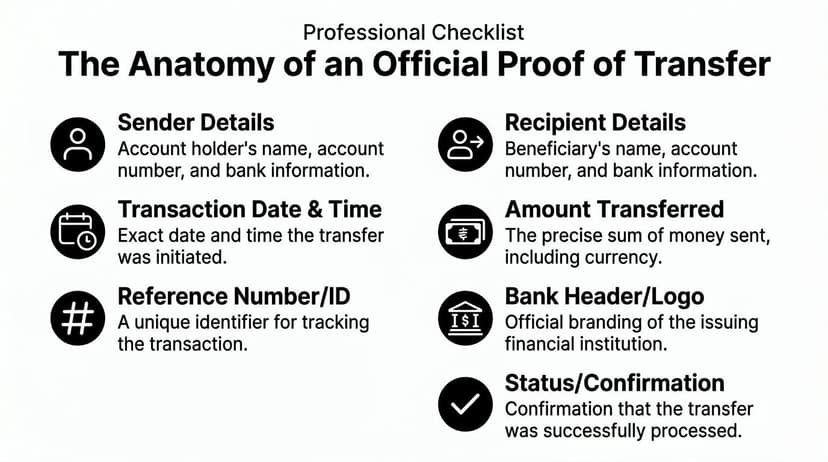
The non-negotiable fields
Across banks and payment systems, proof documents consistently need the same core data points. Hyperbots’ overview of bank transfer documentation notes that official proof documents require six core elements and that incomplete or mismatched information in these fields drives 25-40% of cross-border payment delays.
Core elements
- Sender details
- Recipient details
- Transfer date and time
- Amount and currency
- Unique transaction ID or reference
- Bank-issued context that shows the record is official
Some banks also include a status line such as completed, processed, or successful. That isn’t one of the six core fields cited above, but in practice it’s useful because it answers the immediate objection that the transfer may only have been initiated.
Why each element matters
Sender details tie the transfer to a specific account holder. This matters in visa files, reimbursement disputes, and related-party transactions.
Recipient details matter because many failed proofs show only a partial name, a nickname, or a masked destination. That might be fine for personal banking privacy, but it’s weak for verification.
Date and time establish sequence. If you’re proving you paid before a deadline, or before goods shipped, precision matters.
Amount and currency sound obvious, but they’re where disputes often begin, especially when the paying party assumes the counterparty received the same currency and net amount.
Transaction ID is the backbone of traceability. If this is missing, a reviewer often has no efficient way to match your document with the receiving bank’s records.
Format still matters
Even a complete transaction record can run into trouble if it’s delivered in the wrong file type or with data trapped inside an image. That’s why finance teams often convert statements and confirmations into structured formats depending on the workflow. If you’re trying to understand which export types preserve usable payment data, this comparison of bank statement file formats is a good practical reference.
If the proof can’t be checked quickly, many institutions treat it as if it can’t be trusted.
Acceptable Formats for High-Stakes Verification
The same transfer can require different proof depending on who’s asking. A consulate, a mortgage underwriter, a supplier’s finance team, and a tax examiner don’t evaluate risk the same way, so they don’t accept the same level of evidence.
The simplest way to think about it is this. The higher the consequence of getting it wrong, the more the reviewer wants bank-originated documents with enough detail to verify independently.
Proof of transfer requirements by use case
| Use Case | Accepted Formats | Key Requirement | Common Rejection Reason |
|---|---|---|---|
| Visa or immigration application | Bank statement, bank transfer confirmation PDF, official bank letter | Clear account holder identity and visible movement of funds | Cropped statement, missing name, unclear source of funds |
| Home loan or mortgage review | Recent bank statement, proof-of-funds letter, formal transfer evidence for large deposits | Consistency between account ownership, balances, and transfer trail | Unexplained large credit, edited PDF, missing pages |
| Supplier payment dispute | Bank-generated payment confirmation, statement showing debit, wire confirmation if applicable | Matching beneficiary details and usable transaction reference | Screenshot only, no reference number, “pending” status |
| Business bookkeeping and month-end close | Full statement export, PDF statement, accounting-compatible transaction file | Complete transaction history and consistent reconciliation trail | Manual rekeying errors, partial exports, unsupported format |
| Tax audit or source-of-funds review | Full statement set, transfer proof tied to statement entries, official bank records when requested | Clean chronology and traceable links between deposits and transactions | Gaps in statement period, redacted key fields, unclear ownership |
What usually works best
For visa and immigration matters, a statement is often stronger than a cropped transfer receipt because it shows context. Reviewers want to see the account holder, the account itself, and the funds moving through it. If the transfer was important to the application, pair the transfer proof with the statement entry that reflects it.
For loans, lenders care about ownership, liquidity, and unexplained movements. A transfer confirmation helps, but lenders often want the surrounding statement activity too. A one-page receipt without context can raise more questions than it answers.
For supplier disputes, a bank-generated transfer confirmation or wire confirmation is usually the cleanest starting point. It directly addresses whether payment instructions were executed.
For bookkeeping, statements are often better than screenshots or email receipts because they support reconciliation and audit trails. If the accounting system needs importable data, format choice matters. Many firms compare OFX, QBO, and IIF formats before deciding how to move bank proof into their ledger workflow.
When a supporting legal document helps
Sometimes the issue isn’t the payment itself but the transaction around it. If you’re documenting the sale of an asset, for example, pairing transfer proof with a properly drafted ownership document can make the payment trail much easier to defend. In those cases, a practical template like this AI legal assistant's bill of sale can help create a cleaner package than an informal signed note.
Practical rule: Match the proof to the reviewer’s risk, not to your convenience.
Common Pitfalls and How to Spot a Fake
Most bad proof submissions aren’t fraudulent. They’re just weak. The person sends a cropped app image, a blurry photo of a monitor, or a statement page with the header removed. Then the reviewer asks for more, deadlines slip, and everyone gets annoyed.
Fraud is the more serious issue. Docsumo’s discussion of proof-of-funds verification notes that bank statement verification is a key fraud-prevention tool, and that the UK recorded 3.7 million fraud incidents in the year ending December 2022. That’s why AML and source-of-funds reviews rely on accurate extraction from statements rather than casual visual checks alone.
Submission mistakes that cause preventable rejection
These are the errors I see most often in practice:
- The header is missing. If the bank name, account holder, or statement period is cropped out, the document loses authority immediately.
- The date range doesn’t match the request. A genuine statement can still fail if it doesn’t cover the required period.
- Only one page is provided. Reviewers often assume omitted pages were removed for a reason.
- Key fields are redacted badly. Privacy matters, but if you hide the fields needed for verification, the proof becomes unusable.
- Status is ambiguous. “Scheduled” or “pending” isn’t proof that funds were transferred.
What fake proofs often look like
Fake bank transfer documents tend to reveal themselves in small inconsistencies, not dramatic errors.
Look for font changes inside a single line, uneven spacing around the amount, odd alignment in the beneficiary field, and logos that appear too soft or slightly stretched. Pay close attention to transaction references. Fraudsters often focus on the amount and recipient name but overlook the formatting style the bank normally uses for IDs and timestamps.
A suspicious document can also be too clean. Real statements usually show ordinary account activity, formatting quirks, and the bank’s standard layout conventions. Fabricated statements often look simplified, stripped down, or unusually selective.
If one field looks edited, treat the whole document as unverified until you can confirm it from bank records or statement data.
For teams that review documents at scale, visual inspection alone isn’t enough. Tools built around OCR and structured extraction can help compare balances, transaction order, and field consistency across pages. That’s the practical reason many firms use a dedicated bank statement parser with OCR instead of relying on manual review.
A short walkthrough can help sharpen your eye before you approve a payment proof:
A safer review habit
When someone sends proof of bank transfer, don’t ask only, “Does this look real?” Ask:
- Can I trace this to a bank-issued record?
- Do the names, dates, and amounts match the underlying transaction?
- Is anything missing that prevents independent verification?
That mindset catches both honest mistakes and many fakes.
Automating Proof Extraction for Professionals
For a business owner, one proof document can be a nuisance. For a CPA, bookkeeper, or finance team, a stack of them becomes a workflow problem.
The primary bottleneck usually isn’t understanding what acceptable proof looks like. It’s extracting the relevant data from messy PDFs, scanned statements, and inconsistent bank layouts without introducing errors along the way.
Why manual handling breaks down
According to Stripe’s discussion of proof of bank transfer and statement use, 70% of CPAs report losing over 12 hours per week to manual statement entry, and automated tools address that problem with 99%+ accuracy while fitting into accounting workflows.
That pain is easy to underestimate until you’re doing month-end close, source-of-funds review, or audit support across multiple entities. One mis-keyed amount or one skipped line can break the reconciliation trail that makes the proof useful in the first place.
What good automation changes
A strong extraction workflow does four things well:
- It handles bad inputs. Scanned, rotated, multi-page, or low-quality files still need usable output.
- It structures the data. Dates, descriptions, credits, debits, balances, and references need to land in predictable columns.
- It supports review. Confidence checks and balance reconciliation matter because finance work still needs a human standard.
- It exports where work happens. Excel is common, but accounting systems and audit files matter too.
That shift is broader than bank proof alone. Operations teams are pushing routine document handling into AI-assisted workflows wherever repetitive review creates delay. For leaders thinking about the bigger process picture, this guide to AI automation for COOs is a useful strategic read.
What practitioners should look for
If you’re evaluating a statement extraction tool for proof-related work, check for:
- Multi-bank support, because real clients don’t all bank with the same institution
- Balance reconciliation, so the extracted data can be tested
- Export flexibility, especially for Excel and accounting imports
- Short retention and secure handling, because bank statements contain more personal data than is commonly understood
The best systems don’t just digitize a statement. They convert it into a verifiable dataset that can support bookkeeping, audits, dispute resolution, and financial review without endless manual cleanup.
Frequently Asked Questions
How long is proof of bank transfer considered valid
There’s no universal validity period. The institution asking for the document sets the rule. A supplier resolving a same-week payment issue may accept a recent transfer confirmation, while a lender or visa reviewer may care more about the statement period, the age of the document, and whether it still reflects your current balance position.
The safest approach is to submit the most recent bank-generated document available that clearly covers the relevant transaction.
Is a bank statement better than a transfer receipt
Often, yes. A statement usually provides more context because it ties the transfer to the account holder and surrounding account activity. That makes it more useful for source-of-funds review, loan files, and visa documentation.
If you need a statement specifically for travel or immigration documentation, this practical guide on choosing a bank statement for visa applications can help you avoid common formatting mistakes.
What if my bank won’t issue a special confirmation letter
Use the strongest bank-generated record they do provide. That may be a downloadable PDF transfer confirmation, a full statement showing the debit, or a wire confirmation available through online banking. If you need something more formal, ask the bank exactly what official records they can generate instead of asking broadly for “proof.”
That phrasing gets better results.
Are screenshots ever acceptable
Yes, but mainly in informal settings. For example, a friend, landlord, or small vendor might accept one as a courtesy update. In any regulated, audited, or disputed setting, screenshots are weak evidence unless backed by an official bank record.
Should I redact personal information
Yes, but carefully. Remove information that isn’t needed for the review, especially if you’re sending documents to a third party. Don’t redact the fields that prove ownership, transaction details, or the bank-issued nature of the record. Over-redaction is one of the fastest ways to turn a valid document into an unusable one.
If you handle bank statements regularly and need clean, usable proof without manual retyping, ConvertBankToExcel helps turn PDF statements into structured Excel and accounting-ready files. You can also explore the full set of tools for bank statement conversion and extraction if your workflow involves audits, visa documentation, bookkeeping, or payment verification.