
![ABSA Bank Statement to Excel [2026 Guide]](/_next/image?url=https%3A%2F%2Fconvertbanktoexcel.com%2Fapi%2Fuploads%2Fimages%2Fabsa-bank-statement-to-excel-conversion-workflow-on-professional-laptop-south-africa-1773515102814.jpg&w=1920&q=75)
How to Convert ABSA Bank Statement to Excel [2026 Guide]
ABSA's PDF statements don't open in Excel cleanly. The multi-column layout with transaction descriptions, amounts, and running balances looks fine as a document — but turns into a mess when you try to use it in a spreadsheet.
Here's how to convert it properly, with three tested methods.
Why ABSA Statements Need a Converter
ABSA (Amalgamated Banks of South Africa) is one of South Africa's Big Five banks. Their statement PDFs use a table-based layout with date, transaction description, debit, credit, and balance columns. This structure is consistent, which is good, but it's still a PDF — meaning Excel can't read it directly.
Standard PDF conversion tools extract text without understanding column structure. You end up with everything in one column, or amounts mixing with descriptions. ABSA's long transaction descriptions (especially for card purchases) make this worse.
A proper bank statement converter reads the table structure and maps each value to the right column.
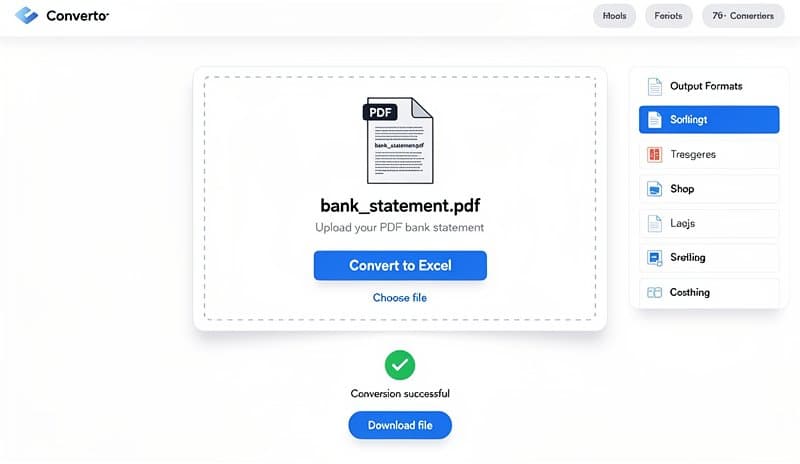
Method 1: Online Converter (Fastest)
Converts an ABSA statement in about 90 seconds:
- Download your ABSA statement as PDF (see next section)
- Go to convertbanktoexcel.com
- Upload your PDF
- Choose Excel or CSV as output
- Download the file
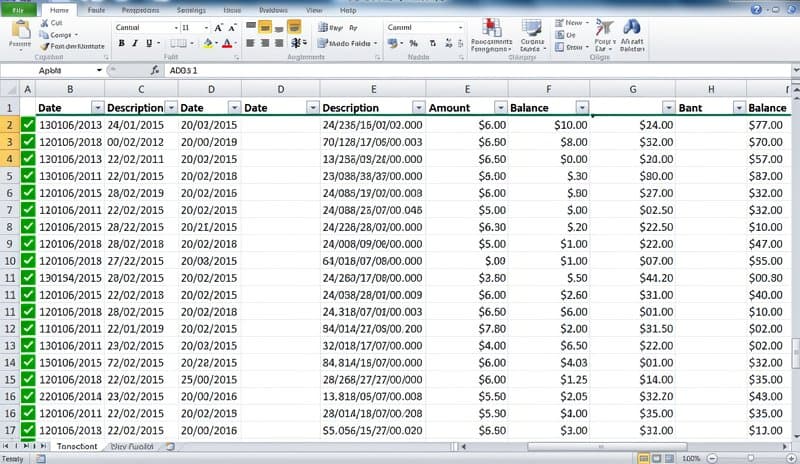
Output: clean spreadsheet with Date, Description, Debit, Credit, and Balance in separate columns. Tested with ABSA's standard personal account statement (red header, ABSA logo format).
You can also choose OFX or QBO output at the same step — useful if you're importing into QuickBooks or Sage.
How to Download Your ABSA Statement
You need the PDF first. ABSA provides it through Absa Online Banking and the Absa Banking App.
Absa Online Banking (absa.co.za):
- Log in with your username and password
- Click My accounts in the top menu
- Select the account you want
- Click Statements in the account menu
- Set your date range — ABSA allows up to 2 years of history
- Choose PDF as the format
- Click Download statement
Absa Banking App (iOS/Android):
- Open the app and log in with your PIN or biometrics
- Tap the account on your home screen
- Tap the menu icon (top right)
- Tap Statements
- Choose your date range
- Tap Download PDF
The PDF saves to your downloads folder or can be shared directly from the app.
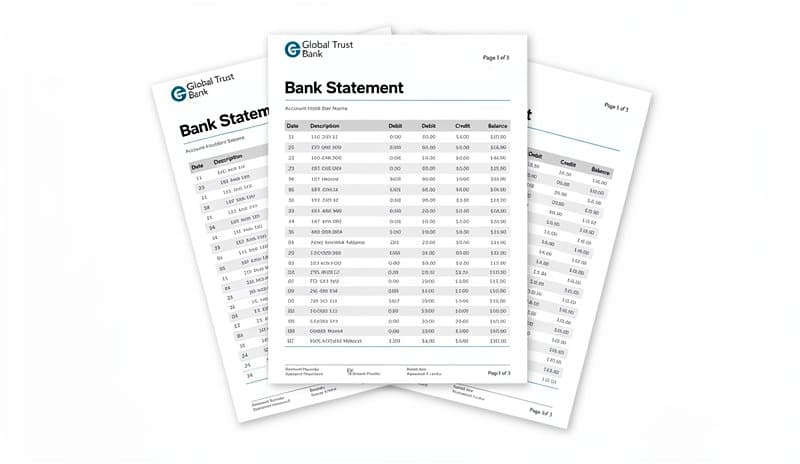
ABSA Statement Formats Available
ABSA offers several download options depending on the account type:
| Format | Available From | Excel Compatible? | Best Use |
|---|---|---|---|
| PDF statement | Online Banking / App | Needs converter | Formal records, full reconciliation |
| CSV download | Online Banking | Yes — direct | Basic transaction tracking |
| XML (some accounts) | Online Banking | Needs parsing | Accounting software imports |
PDF: Most complete format. Includes opening balance, closing balance, full transaction details, and account summary. Required for accountant submissions.
CSV: ABSA Online Banking has a CSV download option. Go to My accounts → Statements → Download CSV. The file opens directly in Excel. Limitations: no running balance column, no account summary header.
For a detailed breakdown of CSV vs PDF for accounting purposes, see our guide on converting bank statements to CSV.
Method 2: ABSA CSV Direct Download
For transaction lists without full reconciliation:
- Log in to Absa Online Banking
- Go to My accounts → your account → Statements
- Select the date range
- Click Download CSV
- Open in Excel — no converter needed
Works perfectly for month-by-month expense tracking or importing into a personal finance spreadsheet. The column structure is clean: Date, Description, Debit/Credit Amount.
Limitations: no opening or closing balance, no account number or statement period header. If your accountant needs a formal statement, use the PDF conversion method.
Method 3: Manual Copy-Paste (Limited Use)
For small numbers of transactions only (under 10 rows):
- Open the ABSA PDF in Adobe Acrobat or your browser
- Switch to selection mode
- Drag to select transaction rows
- Copy and paste into Excel
ABSA's table structure typically results in all columns merging into a single Excel column. You'll need to use Data → Text to Columns to separate them. For a three-month statement, this takes longer than the converter method.
Cleaning Up the Converted Data
After converting, a few common fixes apply.
Date format: ABSA uses DD/MM/YYYY or DD-Mon-YYYY depending on statement type. If Excel reads dates as text, select the column and use Data → Text to Columns → Date: DMY to parse them correctly.
Amounts as text: ABSA amounts use South African number formatting with commas. If Excel imports them as text, find and replace all commas with nothing, then multiply by 1 to force number format. Debit amounts may import as negative — check whether you prefer them that way or as positive values in a separate column.
Blank separator rows: Some ABSA statements include blank rows between months. Select the blank rows and delete, or use Filter to hide and then delete them.
Description cleanup: ABSA card transactions include long reference numbers in the description. If you want cleaner data, you can use Excel's LEFT() or text split functions to extract just the merchant name.
Importing ABSA Data into Accounting Software
Once you have clean Excel data, here's how to get it into common accounting tools:
Xero: Export your Excel as CSV. In Xero, go to Bank Accounts → Import Statement → Upload CSV. Map the date, description, and amount columns on the import screen.
Sage Accounting: Similar CSV import. Go to Banking → Import Transactions → Upload CSV file. ABSA's column format maps cleanly.
QuickBooks: QuickBooks Desktop and QBO prefer OFX or QBO format. Upload your ABSA PDF to convertbanktoexcel.com and choose OFX as the output format — same file, different download.
Wave: CSV import works. Same process as Xero.
ABSA vs Other South African Bank Statements
If you bank with multiple South African institutions, here's how ABSA compares:
| Bank | Statement Layout | Conversion Quality |
|---|---|---|
| ABSA | Two-column, red header | Good — consistent format |
| FNB | Multi-column, orange header | Good — standard Big Four layout |
| Standard Bank | Multi-section, blue header | Good — consistent |
| Capitec | Simpler table, color-coded | Excellent — very clean |
| Nedbank | Table-based | Good |
ABSA's format is stable across their product range — personal, business, and credit card accounts all use a similar structure. If you also use Capitec, check the Capitec Bank Statement to Excel guide — Capitec's app offers a direct CSV export that skips the conversion step entirely.
Supported ABSA Account Types
The converter handles all main ABSA account types:
- Personal cheque accounts (Gold, Silver, Prestige)
- Savings accounts (FlexiSave, MoneyBuilder)
- ABSA credit card statements
- ABSA Vehicle Finance statements
- Home Loan account statements
- ABSA Business current accounts
- ABSA Business credit cards
Business account statements sometimes use a slightly wider column layout. If you see columns misaligned in the output, try uploading a single-page sample first to check the result before processing a full year.
ABSA-Specific Notes
A few things that catch people out:
Password-protected PDFs: ABSA occasionally sends password-protected statements by email. The password is typically your South African ID number. Enter it in Adobe Reader or your browser's PDF viewer, then save an unlocked copy before uploading to the converter.
ABSA Reward statements: Cheque account statements include Reward transaction lines mixed with regular transactions. These convert with the same structure — just filter by description if you want to separate Reward activity.
Joint accounts: Joint account statements show both names. This doesn't affect conversion — the table structure is identical.
Older format statements: ABSA updated their statement template in 2021. Pre-2021 statements have a different header layout but the transaction table structure is similar — the converter handles both.
ABSA Forex accounts: Foreign currency account statements show the foreign currency amount and the ZAR equivalent. Both columns are captured in the conversion.
Frequently Asked Questions
Can I convert ABSA statements without registering?
Yes. Upload your PDF and download the result — no account needed.
How many months can I convert at once?
ABSA typically issues one PDF per statement period (usually monthly). For full-year reconciliation, download monthly statements and convert each separately, then combine in Excel.
Does the converter work with ABSA business accounts?
Yes. Personal and business account statements both work. Business statement templates are slightly wider but the converter handles both.
What output formats are available?
Excel (.xlsx), CSV, OFX, QBO, and JSON. Choose based on what your accounting software accepts.
Which other banks are supported?
ABSA is one of 2,000+ banks supported globally, including all major South African, UK, US, and European banks.
Is my financial data secure?
Files are processed for conversion and deleted after the session. Data is not stored, shared, or retained.
Conclusion
ABSA statements convert cleanly with the right tool. Fastest option: upload your PDF to convertbanktoexcel.com and download Excel in under 2 minutes — no signup, no software required.
For transaction-only tracking, ABSA's own CSV download from Online Banking gives you data directly in Excel without a converter. For full reconciliation or accounting software imports, PDF conversion gives you everything: dates, descriptions, debits, credits, and running balance in separate columns.
Start converting for free — handles all ABSA account types, personal and business.