
You already have the statements. That usually isn't the actual problem.
The core issue is that a bank statement is raw evidence, not a finished argument. A lender, landlord, visa officer, or tax examiner doesn’t want to sort through pages of transfers, card payments, refunds, and irregular deposits to guess what counts as income. They want a clean, credible narrative backed by bank-issued records.
That gap trips people up constantly. A self-employed consultant submits six months of statements with healthy deposits, then gets asked why balances dip mid-month. A freelancer sends screenshots from a banking app and assumes that’s enough. A bookkeeper exports transactions into a spreadsheet but forgets to separate owner transfers from client payments. The documents are real, but the presentation invites questions.
I’ve seen the same pattern for years. The people who get approved faster usually aren’t the ones with perfect income. They’re the ones who make their income easy to verify.
Why Your Bank Statement Is More Than Just a Record
A bank statement looks simple until someone uses it to decide whether you qualify for something important.
For salaried employees, pay stubs and tax forms often do the heavy lifting. For everyone else, the bank statement ends up carrying more weight. Bank statements are among the top 3 most commonly accepted proof-of-income documents, alongside pay stubs and tax returns. Their role is especially important for 36% of U.S. workers in informal sectors and for the 15-20% of U.S. mortgage applicants who are self-employed, because they show cash flow over a 3-6 month period that lenders use to judge stability, as noted in Ondato’s proof-of-income overview.
That’s why bank statements as proof of income matter so much now. They don’t just show that money entered an account. They show timing, consistency, source patterns, and whether the account holder manages cash flow in a way that looks sustainable.
Raw transactions don’t explain themselves
A statement is a ledger. It isn’t a summary.
If a client gets paid by five customers, two platforms, and one overseas marketplace, the deposits may be legitimate and recurring. But on the page, they can still look messy. The reviewer sees mixed descriptions, uneven payment dates, transfers between accounts, maybe a refund or a family reimbursement. Without context, income gets buried inside activity.
That’s where many applications stall. Not because the applicant lacks income, but because the statement hasn’t been translated into something a reviewer can trust quickly.
Practical rule: A strong submission doesn’t force the reviewer to interpret your cash flow. It shows them exactly what counts as income and why.
A good statement package tells a financial story
The best bank statement package does three things at once:
- Shows continuity: recurring deposits over the requested period
- Separates noise from income: transfers, refunds, and one-off items don’t get mixed with earnings
- Answers obvious questions early: unusual deposits, account switches, and seasonal dips are explained before they become objections
That’s the part most generic guides miss. They explain what a bank statement is, but not how to make it persuasive.
A usable statement package isn’t just downloaded from online banking and attached to an email. It’s prepared. Names match the application. Date ranges align. Income-related transactions are identifiable. Large non-income items are annotated. If there are multiple accounts, they’re organized instead of dumped into one folder and left for someone else to piece together.
That difference matters more than is commonly understood.
Who Requires Bank Statements and Why
The same statement gets read very differently depending on who requested it.
A mortgage underwriter is trying to judge durability of income and whether the applicant can carry ongoing obligations. A landlord usually wants a simpler answer: will rent get paid reliably and on time? A visa officer often cares about solvency, consistency, and whether the funds shown make sense across borders and supporting documents. Tax authorities take a more forensic view.

For international visa and mortgage applications across the US, UK, and EU, verifiers often ask for 6-12 months of statements. That becomes more complicated when income comes through multiple accounts or currencies. It’s also become more common as digital nomad applications have risen. One published guide cites a 45% increase in post-2025 digital nomad visa applications and notes how overlooked multi-currency consolidation can be in these cases, as discussed in Apartment List’s proof-of-income guide.
What changes from one verifier to another
You don’t improve an application by sending more pages. You improve it by matching the package to the reviewer’s goal.
| Verifier | Primary Goal | Key Red Flags to Avoid |
|---|---|---|
| Mortgage lender | Confirm stable income and overall repayment capacity | Irregular unexplained deposits, missing pages, transfers presented as income, balances that suggest cash strain |
| Landlord or property manager | Confirm rent affordability and reliable monthly cash flow | Recent overdraft-like behavior, incomplete statement period, obvious instability in deposit timing |
| Visa or immigration officer | Confirm financial solvency and traceable funds | Multi-currency activity with no explanation, inconsistent balances across accounts, unsupported large credits |
| IRS or tax examiner | Reconstruct income and compare deposits to reported earnings | Undocumented deposits, commingled business and personal transactions, poor records supporting non-income items |
Mortgage files need cleaner packaging than most people expect
Mortgage reviewers rarely want a pile of PDFs and a promise that “everything is in there.” They want consistency they can confirm without guessing.
That’s especially true for self-employed borrowers and applicants using bank statements as proof of income. If that’s your use case, it helps to understand how mortgage-focused bank statement preparation is usually handled. The core issue isn’t just income level. It’s whether the deposit pattern looks dependable enough to underwrite.
Visa files fail for different reasons
Visa applications often get underestimated because applicants assume proof of funds and proof of income are the same thing. They aren’t.
A healthy account balance may help, but officers still look for coherence. If money moves between countries, accounts, or currencies, the records need to show a believable trail. If income is freelance or contract-based, unexplained volatility can become the issue even when total income is adequate.
A reviewer doesn’t reward complexity. They reward clarity.
Tax authorities read statements more aggressively
Tax review is a different exercise altogether. The statement isn’t just evidence of ability to pay. It can become evidence of underreported income if deposit patterns conflict with filed returns or books.
That’s why sloppy categorization causes problems. If transfers, reimbursements, and client receipts all sit together without support, the account holder ends up having to explain the statement under pressure instead of controlling the narrative upfront.
Decoding Your Statement The Way a Lender Does
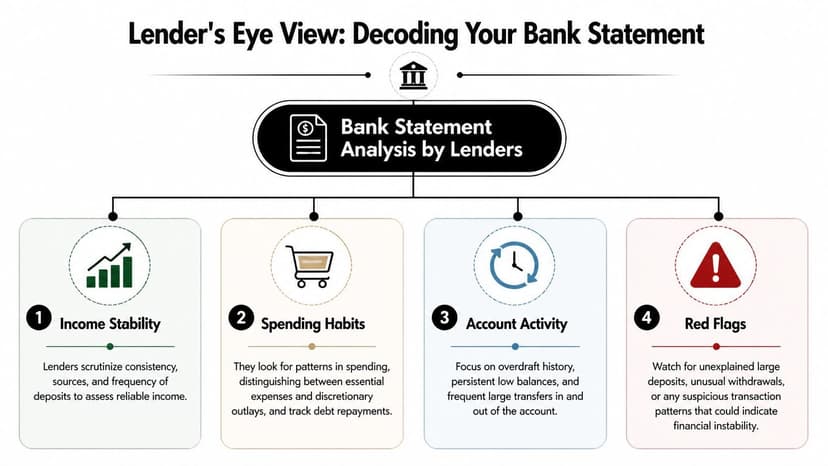
Individuals typically read a statement from top to bottom. Underwriters don’t.
They scan for patterns first. They want to know where deposits come from, how often they arrive, whether balances hold up between income dates, and whether anything on the statement contradicts the story told in the application.
Start with deposit consistency
The first pass is simple. Which deposits are recurring, and which are noise?
Automated verification tools already do part of this work. They analyze variability in deposits, and high variance above 30% can trigger rejection rates up to 40% higher. The same systems also screen for manipulated PDFs, which can increase false positives by 25%, so official bank-issued copies matter, as explained in Ocrolus’s bank statement verification article.
That aligns with real underwriting behavior. Stable deposits usually get fewer questions. Erratic deposits demand explanation, even when the annual total looks acceptable.
Here’s the practical review method I use:
- Mark true income sources first. Client payments, payroll deposits, platform payouts, pension credits, and recurring contract receipts belong in one group.
- Strip out non-income items. Internal transfers, refunds, loan proceeds, reimbursements, and one-off personal deposits should not inflate monthly income.
- Check timing. Weekly, biweekly, semimonthly, or monthly patterns matter more than applicants realize.
- Compare statements across months. One good month doesn’t rescue a weak pattern across the requested period.
Balance behavior matters more than applicants think
A lender isn’t only reviewing what comes in. They’re checking what remains.
An account that receives strong deposits but repeatedly drops to low balances tells a different story from one that maintains a cushion. The same is true for frequent transfers out to cover shortfalls elsewhere. Those patterns can suggest the applicant is managing liquidity tightly, even if gross deposits look healthy.
Founders often get confused on this point. Revenue and cash availability aren’t the same thing. Numeric App has a useful note on financial insights for founders that makes the distinction clearly. It’s relevant here because reviewers are often looking at cash behavior, not just reported profitability.
If your statement shows strong income but weak cash retention, expect questions about reserves, obligations, or debt pressure.
Spot your own red flags before submission
The best applicants audit themselves before the lender does.
Use this short review list:
- Large unusual deposits: explain where they came from and whether they count as income
- Frequent returned items or account penalties: these suggest weak account management
- Undisclosed debt payments: recurring loan, card, or finance payments often surface on statements even when applicants forget to mention them
- Mixed personal and business activity: this muddies the income calculation and slows review
If you’re doing this manually, structured extraction helps. A clean workflow for extracting bank statement data makes it much easier to isolate recurring deposits, compare months, and prepare an explanation sheet that matches the statement line by line.
The strongest statement packages don’t pretend the account is perfect. They identify imperfections early, classify them correctly, and remove avoidable ambiguity.
Common Mistakes That Trigger Instant Rejection
The rejection usually isn’t caused by one dramatic problem. It’s caused by a small mistake that signals carelessness, inconsistency, or avoidable risk.
This happens constantly with self-employed applicants and gig workers. A published verification guide notes that there are 1.57 billion gig workers worldwide, and that irregular deposit patterns are the biggest challenge in this category. It also notes that around 70% of U.S. lenders require consistency over 2-3 months for bank statement loans, and that failing to show that pattern is a common reason for denial, especially when earnings may fall below the $600 threshold for a 1099, according to Diro’s proof-of-income verification guide.
Screenshots, cropped PDFs, and partial exports
What they did: submitted app screenshots or a transaction list copied from online banking.
What they should have done: submitted full bank-issued statements with all pages intact.
This sounds basic, but it still causes immediate pushback. Screenshots don’t show statement continuity, page counts, or formal issuance. Cropped exports also create suspicion because they look curated, even when the transactions are real.
Wrong date range
What they did: sent the most recent statement only, or mixed non-consecutive months.
What they should have done: matched the exact date range requested and checked whether the reviewer wanted full statements or a rolling period.
This is one of the fastest ways to look unprepared. If the request says the last several months, send exactly that period. Don’t make the reviewer ask for missing months.
Mixing business, personal, and transfer activity
What they did: treated every inbound credit as income.
What they should have done: separated earned income from transfers, reimbursements, and owner movements between accounts.
Often, otherwise strong “good income” files become problematic. The statement may show enough money overall, but if the income line is inflated by transfers, the credibility of the whole package drops.
A clean process for working with scanned statements also matters here, because low-quality scans make line-item review harder and increase the chance that real income gets mixed with non-income activity.
Poor redaction
Some applicants redact aggressively and hide information the reviewer needs to assess authenticity. Others redact nothing and create privacy problems they could have avoided.
The right approach is narrow. Remove only what isn’t required and only if the institution allows it. Leave names, dates, balances, transaction continuity, and identifying statement details intact.
A short explainer on common review issues is worth watching before you submit:
No explanation for obvious anomalies
What they did: hoped the reviewer wouldn’t notice a large cash deposit, sudden spike in income, or temporary lull.
What they should have done: attached a short note and supporting context.
The worst time to explain a strange deposit is after the reviewer has already decided it looks suspicious.
A one-page cover note solves many of these issues. If a deposit came from selling equipment, moving funds between your own accounts, or collecting a seasonal client payment, say so plainly. Silence almost always looks worse than a concise explanation.
Your Pre-Submission Checklist and Sample Wording
By the time a statement package reaches underwriting, review is largely mechanical. That’s good news if you prepare for it. It’s bad news if you assume the reviewer will infer what you meant.
A final quality-control pass catches most avoidable problems.
Pre-submission checklist
Use this before you upload anything:
- Match the identity details: your name, address, and account details should align with the application and supporting documents.
- Confirm the date range: send the exact months requested, in order, with no gaps.
- Check page completeness: every page must be present, even if one page seems unimportant.
- Use official files: download statement PDFs from the bank, not screenshots or copied transaction histories.
- Separate income from non-income: identify transfers, refunds, reimbursements, and one-time credits before you summarize income.
- Flag unusual items early: if a reviewer is likely to ask about it, explain it before submission.
- Keep multi-account files organized: label each account clearly and note why more than one account is being provided.
- Verify readability: blurred scans, sideways pages, and low-contrast uploads invite delays.
If you’re preparing a mortgage package, it also helps to understand broader factors for mortgage approval so your statement evidence supports the rest of the file instead of existing in isolation.
Sample wording you can adapt
These notes should be short, factual, and specific. Don’t oversell. Don’t sound defensive.
For a large one-time deposit
“The deposit dated [date] was not recurring income. It represents proceeds from the sale of a personal asset. It should be excluded from average monthly income calculations.”
For multiple freelance clients
“My income is received from several recurring clients rather than a single employer. The attached summary identifies recurring deposits by client name and month so earned income can be reviewed separately from transfers and reimbursements.”
For a temporary dip in earnings
“Income during this period was lower than usual due to a temporary slowdown in client billing. Deposits resumed afterward, and the attached statements show the return of regular receipts.”
Visa-specific wording
For visa files, clarity matters even more when income arrives through more than one bank or in more than one currency.
A short note can say: “The attached statements cover my primary operating account and my secondary receiving account. Foreign currency deposits were converted by the bank before crediting the account. The accompanying summary shows recurring income sources and excludes internal transfers.”
If you’re assembling that kind of package, a focused guide on the bank statement for visa process can help you organize multi-account evidence more cleanly.
The goal isn’t to write a long explanation. It’s to remove doubt before doubt becomes a document request.
Automate Your Proof of Income with ConvertBankToExcel
Manual statement prep breaks down fast when the files are messy.
That’s the daily problem for firms, bookkeepers, and applicants with multiple accounts. Statements arrive as scans, locked PDFs, phone downloads, low-quality exports, or foreign-language files. The bank’s format changes. The account description labels change. The statement is valid, but working with it is slow.
A published extraction guide puts the bottleneck plainly. CPAs and bookkeepers deal with 2,000+ global bank layouts and often lose over 12 hours a week to manual handling. The same guide notes that AI OCR tools with 99%+ accuracy are becoming the practical solution because they handle non-standard formats and batch work more effectively for loan and tenant screening, according to Docsumo’s write-up on proof-of-income verification.
Why automation makes sense here
Automation helps when it does three things well:
- Standardizes inconsistent layouts
- Preserves transaction-level accuracy
- Creates outputs that are usable for review, reconciliation, and supporting schedules
That’s why this category of software has become useful beyond pure bookkeeping. It now sits inside mortgage prep, visa support, audit cleanup, and income verification workflows.
There are several approaches on the market. If you’re comparing options for broader finance workflows, Mintline for automated accounting is one relevant example of how teams are using statement conversion in accounting operations.
What ConvertBankToExcel solves in practice
ConvertBankToExcel is built for a very specific pain point: turning raw bank statements into structured, review-ready data without hand-keying every line.
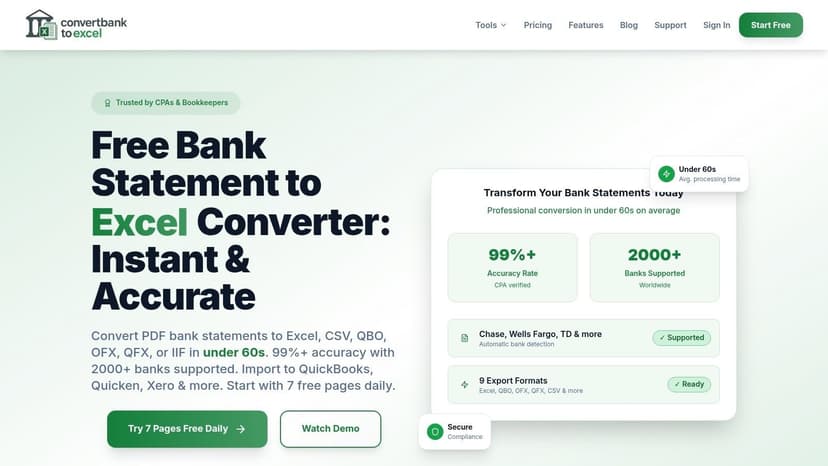
In practical terms, that means you can take scanned or digital statements, convert them into Excel or CSV, and work from a structured file instead of a stack of PDFs. For accountants and support staff, that removes one of the biggest failure points in bank statements as proof of income: inconsistent manual extraction.
The value isn’t just speed. It’s control.
You can review deposits by source, isolate transfers, create monthly summaries, and reconcile balances without rebuilding the statement by hand. That’s especially useful when a client has more than one account, mixed income sources, or statement PDFs that aren’t clean enough for ordinary copy-paste work.
Better workflow, cleaner submissions
For loan, visa, and rental files, structured exports make it easier to prepare the summary page that reviewers need. For bookkeepers and CPAs, they also reduce the repetitive cleanup that tends to happen right before a deadline.
A direct statement converter workflow is useful when you need to move from raw PDF statements to usable spreadsheets quickly. And if you want to see the broader toolset, ConvertBankToExcel also maintains its full tools library for statement conversion and related workflows.
I’m skeptical of “easy button” software in finance. Most of it promises convenience and then creates cleanup work somewhere else. The reason statement automation is different is simple: the source material is repetitive, structured enough to extract, and painful to process manually. When the output is accurate and reviewable, the time savings are real and the submission quality improves.
If you need cleaner bank statements as proof of income, ConvertBankToExcel helps turn raw PDFs into structured Excel, CSV, and accounting-ready files that are easier to review, summarize, and submit with confidence.