
![Fake Bank Statement: A CPA's Guide to Detection [2026]](/_next/image?url=https%3A%2F%2Fconvertbanktoexcel.com%2Fapi%2Fuploads%2Fimages%2F1777792430828-65f8befe.jpg&w=1920&q=75)
A client sends over a PDF bank statement late on a Friday. It’s needed for underwriting, a cleanup engagement, litigation support, or a cash proof for year-end. The document looks polished. The balances are healthy. Nothing is obviously wrong, but something about it feels too tidy.
That instinct matters more than many firms admit.
A fake bank statement is no longer just a sloppy screenshot with mismatched fonts. The harder cases involve real statements that have been edited just enough to change the decision that depends on them. If your review process still depends on a quick eyeball test, you’re exposed. The cost isn’t limited to one bad file. It can flow into loan decisions, tax positions, reconciliations, audit support, and client acceptance.
The Growing Problem of Document Fraud
Most professionals meet this problem in a very ordinary way. A borrower submits statements for a mortgage review. A bookkeeping client uploads PDFs for monthly reconciliation. A business owner needs support for a visa or financing package. The file arrives through email or a portal, and everyone assumes the PDF is a neutral record of what the bank issued.
It often isn’t.
Forensic investigators at J.S. Held documented a pattern that accountants should take seriously. Fraudsters use software such as Adobe Acrobat Pro to edit PDFs directly, changing transaction descriptions and amounts, and those changes can be visually undetectable without comparing the file to the original from the bank in their discussion of fraudulent manipulation of bank statements in electronic format. That changes the risk profile of every workflow built around client-submitted statements.
Why routine review fails
Traditional review works well against clumsy fraud. It catches obvious spelling mistakes, broken logos, strange margins, and pages that don’t match. It fails against statements built from authentic source files and edited carefully enough to preserve the overall look.
That’s why this issue belongs in risk management, not just document review. If a firm imports altered transactions into its books, the damage spreads quickly:
- Reconciliations go off course because the imported cash activity is wrong from the start.
- Financial analysis becomes unreliable when balances, inflows, or merchant descriptions were changed before anyone touched Excel.
- Professional exposure increases if a lender, regulator, or opposing counsel later asks how the document was validated.
A polished PDF is not evidence of authenticity. It’s only evidence that someone produced a polished PDF.
Where the pressure shows up
The issue is operational. Teams are under deadlines, clients want quick answers, and PDF statements are still a common submission format. That combination creates a weak point. The more compressed the turnaround, the easier it is for a manipulated statement to move through intake, review, and posting without a serious challenge.
By 2026, no serious accounting workflow should treat a bank statement PDF as self-authenticating.
Anatomy of a Fake Bank Statement
Not every fake bank statement is created the same way. Lumping all of them together leads to bad controls. In practice, I’d separate them into three categories because each one leaves a different trail.
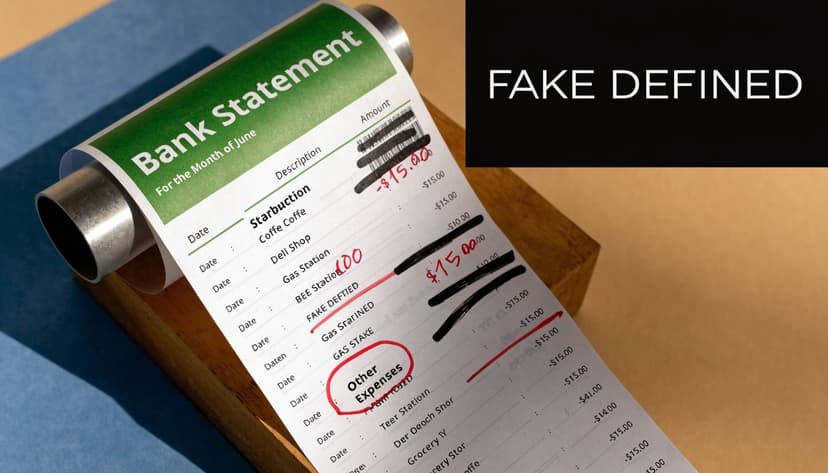
Altered genuine statements
This is the version that causes the most trouble. The fraudster starts with a real bank-issued PDF, then edits selected fields. According to J.S. Held, manipulators use tools like Adobe Acrobat Pro to change descriptions and amounts directly in the PDF, often without converting the file first. Those edits can be very hard to spot visually when the reviewer doesn’t have the original for comparison.
Common edits include:
- Inflated deposits that make income or available cash look stronger.
- Changed payment descriptions that hide transfers, overdrafts, or debt activity.
- Adjusted running balances so the arithmetic still appears coherent at a glance.
These files are dangerous because much of the document is genuine. Reviewers see a real institution name, real branding, real account history, and assume the whole file is trustworthy.
Forged statements built to imitate a bank
A second category is the full imitation. Someone recreates the look of a bank statement without starting from an authentic original. They copy layout, headings, typography, and transaction tables well enough to pass casual review.
This type often falls apart under closer inspection. Spacing may drift. Merchant descriptions may sound generic. The file may show creation traces from consumer software instead of bank systems. Format references in bank statement file formats and structures are helpful here because they train reviewers to expect consistency across dates, columns, and export behavior.
Fabricated template statements
The third category starts from editable templates distributed online. These are marketed as convenience files, but in practice they lower the skill needed to produce convincing fake records. The fraudster fills in names, dates, balances, and transactions, then exports the result as a PDF.
Why these documents fool smart people
A fake bank statement works when the fraudster changes the decision-making variable while preserving everything else. They don’t need to recreate a whole banking system. They only need to alter the part a lender, accountant, or reviewer cares about.
Practical rule: If the statement came from the client, assume it may have been edited until the workflow proves otherwise.
That mindset isn’t cynical. It’s basic financial hygiene.
Common Uses and Severe Legal Dangers
Fake statements show up where a single PDF can facilitate money, approval, or credibility. The pressure point is always the same. Someone needs to prove liquidity, income, reserves, or financial stability, and the reviewer is asked to trust a document that arrived from the applicant.
Where they get used
The most common settings are high stakes and document heavy:
- Mortgage and loan applications where balances and inflows affect approval.
- Visa and immigration submissions where financial capacity must be shown.
- Litigation and family law matters where cash movement becomes evidence.
- Accounting intake and cleanup work where the firm relies on PDFs to rebuild books.
In major markets, fake statement templates for personal use and loan applications are reportedly rising, with downloads spiking 50% in late 2025 and 25% of small firm audits flagging discrepancies tied to tampered client-submitted files, according to reporting on bank statement template misuse. Even if that activity sits outside your direct client base, the underlying message is clear. More altered files are moving into ordinary business workflows.
For mortgage-specific reviews, the operational issues often start before fraud detection. Teams already struggle with formatting inconsistencies, statement gaps, and source verification. That’s why guidance around a bank statement for mortgage review matters operationally, even before you reach the fraud question.
What happens to the person submitting the fake
The immediate consequence is usually denial. After that, the exposure depends on the context. A fake statement used to obtain credit, immigration benefits, or a litigation advantage can trigger fraud allegations, document examination, and downstream reporting obligations.
That’s the visible side. There’s also a quieter consequence. Once an institution believes someone submitted altered financial records, future applications get judged through that lens.
A short explainer is worth watching if your team trains on real-world lending risk:
The liability for firms that miss it
Accounting firms sometimes treat fake statements as the client’s legal problem. That’s too narrow. If your staff accepted a manipulated file, posted transactions from it, or relied on it in a deliverable, the firm may face questions about competence, supervision, and documentation.
That doesn’t mean every missed fake creates legal liability. It does mean every firm needs a defensible review process. Without one, the file becomes more than a bad document. It becomes evidence that your controls were weak.
A bad statement can be contained. A bad workflow repeats the same mistake across every client file.
Forensic Detection Techniques for Accountants
Good detection starts by separating what a human can observe from what a file reveals technically. Those are different disciplines. Strong reviewers use both.
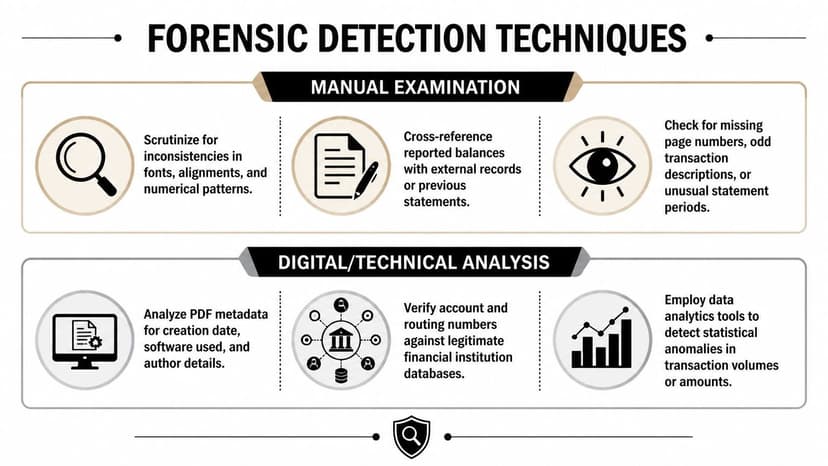
Manual examination
A manual review still matters. It won’t catch everything, but it often tells you where to investigate further.
Watch for visual and logical inconsistencies such as:
- Font drift. One row looks slightly heavier, narrower, or differently spaced than the rest.
- Alignment issues. Decimals don’t sit cleanly in a column, or cent values drift left and right.
- Odd transaction language. A merchant description sounds vague where the bank usually presents standardized details.
- Statement structure problems. Missing page numbers, broken continuation logic, or date ranges that don’t read naturally.
- Balance behavior that feels manufactured. Numbers look curated to support a story rather than reflect lived activity.
Reviewers who want a broader framework for identifying financial irregularities can borrow useful thinking from statement fraud work in adjacent financial investigations. The point is to train the eye without pretending the eye is enough.
Digital and technical analysis
The stronger evidence usually sits below the visible layer. Ocrolus notes that automated AI tools detect up to 4X more fraud than manual reviews by analyzing PDF properties such as Producer fields, and that legitimate statements are generated by bank systems rather than consumer tools like Word or Acrobat in its guide to spotting fake bank statements through metadata and file fingerprints.
That changes how accountants should think about verification. The question isn’t only “Does this look right?” It’s also “Does this file behave like a bank-generated document?”
Key technical checks include:
Metadata review
If the Producer or Creator field points to consumer editing software, the file deserves escalation.Revision traces
Multiple modifications in a statement that should be system-generated are hard to justify.Raster artifacts
Halos, fuzzy text edges, or local pixel softness often show where content was erased and replaced.Arithmetic coherence
If transactions don’t reconcile from opening to closing balance, the file may have been edited or badly fabricated.
For teams extracting data before review, a bank statement parser with OCR can help surface structure and balance issues that are easy to miss in raw PDFs, especially when statements are scanned or low quality.
Red flags and their digital fingerprints
| Red Flag Category | What to Look For (Visual/Manual Check) | What It Means (Digital Fingerprint) |
|---|---|---|
| Fonts and spacing | Inconsistent type weight, uneven character spacing, odd cent alignment | Edited text layers or non-bank software output |
| Balance logic | Running balance feels off or totals don’t flow naturally | Broken transaction math, altered rows, incomplete edits |
| Page structure | Missing pages, odd page order, strange statement periods | Reassembled PDF or template-based fabrication |
| Image quality | Fuzzy patches, halos, blurred local areas | Erasure and retyping, clone stamping, raster tampering |
| File origin | Clean-looking PDF with no visible flaws | Metadata may show consumer tools instead of bank production systems |
| Merchant descriptions | Generic wording where detail is expected | Manual replacement text or synthetic content generation |
What works and what doesn’t
Manual review works best as triage. It is fast, cheap, and useful for deciding which files need deeper validation. It does not work as a final control for advanced fakes.
Technical inspection works better because it tests the file’s origin and internal consistency, not just its appearance. That’s why the strongest workflows combine skepticism, reconciliation, and machine-assisted analysis rather than relying on a senior reviewer’s instincts alone.
A CPA's Step-by-Step Verification Workflow
Detection improves when it becomes a standard process instead of an individual talent. A reliable workflow reduces judgment errors, documents your reasoning, and gives junior staff a repeatable method.
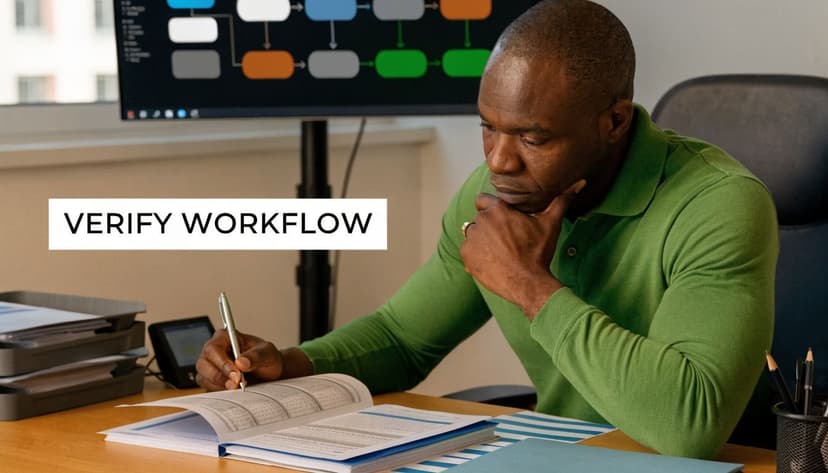
Step one, screen the file before using it
Start before import, booking, or analysis. The first question is whether the statement should be trusted enough to enter the workflow at all.
Use a short intake screen:
- Confirm the source. Was it downloaded from a bank portal, received through a verified institution channel, or merely emailed by the client?
- Scan for structural oddities. Look at page sequence, statement period, account masking style, and consistency across pages.
- Check visible formatting. Fonts, decimal alignment, spacing, and transaction descriptions should read consistently.
- Pause on unexplained perfection. A statement with unusually clean balances and no friction points may deserve more scrutiny, not less.
Step two, reconcile the math
This step is underrated. Veryfi explains that IDP systems validate statement integrity by computationally verifying arithmetic consistency, and discrepancies in totals indicate fraud in over 70% of edited forgeries because manual alterations introduce human error in its explanation of modern bank statement verification methods.
You don’t need a full forensic lab to benefit from that idea. Reconciliation should be mandatory.
Check:
- Opening balance to closing balance
- Deposit and withdrawal flow
- Running balance continuity
- Whether any inserted row causes a break in sequence
If your team sees repeated arithmetic mismatches during cleanup or import, treat them as integrity issues first and formatting issues second. Workflows built around reconciliation mismatch handling are useful because they force the reviewer to resolve the break instead of posting around it.
Don’t ask whether the statement is probably fine. Ask whether the numbers prove the statement is internally coherent.
Step three, escalate to technical validation
A senior reviewer can spot many weak fakes. A strong fake needs file-level testing. Firms often fall short at this stage. They stop after visual review because the document “looks bank-like.”
That approach doesn’t scale, and it doesn’t protect the firm well. Advanced edits can survive a careful human read. Technical validation is what tells you whether the PDF has the fingerprints of a bank output or a desktop editing session.
Step four, document the disposition
Every suspicious file should end with a documented outcome:
- Accepted after validation
- Accepted with limitations and noted uncertainty
- Escalated for source confirmation
- Rejected from use
The important part isn’t only the result. It’s the fact that your workpapers show how the decision was made.
Why manual-only workflows break down
Manual review is slow, subjective, and hard to standardize across a team. It also depends too much on who happens to open the file. One manager notices decimal drift. Another misses it because they’re trying to clear ten client uploads before lunch.
A modern workflow needs three things manual review alone can’t provide consistently: structured extraction, arithmetic checking, and repeatable validation across large volumes. That’s the difference between “we looked at it” and “we verified it.”
How to Prevent Fraud and Respond to an Incident
The best time to deal with a fake bank statement is before it enters your books, your engagement file, or your underwriting packet. Firms that handle this well don’t rely on heroic reviewers. They build policies that reduce the number of risky documents that need judgment in the first place.
Prevention controls that are worth the effort
Start with source control. Whenever possible, obtain statements directly from the financial institution or through a verified portal instead of accepting client-forwarded PDFs as primary evidence. That single change removes a large share of avoidable risk.
Then tighten the document process itself. Teams that standardize intake, naming, retention, exception handling, and review notes usually catch more issues earlier. If your firm is cleaning up its internal workflow, this guide on streamlining document processes offers useful operational thinking that applies well to accounting environments.
Other controls matter too:
- Require escalation rules for altered-looking PDFs, missing pages, or unexplained balance anomalies.
- Separate extraction from acceptance so posting data doesn’t automatically validate source integrity.
- Use scanned-statement controls because low-quality files create room for both error and manipulation. Workflows for handling scanned statements are especially important where clients still submit image-based PDFs.
DocuClipper reports that modern AI analysis platforms can reach 99% fraud detection rates by validating 50+ fraud signals, and can cut manual review costs by up to 80% in its overview of AI-driven bank statement analysis. The practical takeaway isn’t that software replaces judgment. It’s that firms should stop treating manual review as the only serious control.
What to do when you confirm a fake
Once you conclude a statement is fraudulent, the response needs to be controlled and boring. That’s good. Drama creates risk.
Follow a disciplined sequence:
- Preserve the evidence. Save the file, notes, metadata findings, and comparison work securely.
- Stop relying on the document. Don’t let it flow into reconciliations, reports, or client deliverables.
- Escalate internally. Involve the engagement partner, compliance lead, or designated risk owner.
- Get legal guidance. Your obligations differ by engagement type, industry, and jurisdiction.
- Manage the client relationship carefully. Don’t make casual accusations. Use the firm’s formal process.
Non-negotiable: Once a statement is confirmed false, treat the matter as a firm-risk issue, not a bookkeeping cleanup issue.
That distinction protects your staff, your workpapers, and your reputation.
If your team needs a faster way to extract and validate statement data before it reaches the ledger, ConvertBankToExcel is built for CPA and bookkeeping workflows. It converts digital and scanned statements into structured outputs for Excel, CSV, QuickBooks, Xero, and other formats, with balance checks, confidence scoring, and support for high-volume review.