
Messy books rarely look dramatic from the outside. They look like a Profit & Loss statement that doesn’t match reality, a balance sheet with numbers nobody trusts, and a growing pile of statements, receipts, and half-finished categorizations that someone keeps promising to “deal with later.”
By the time most owners look for bookkeeping cleanup services, they aren’t being careless. They’re stuck. Tax season is close. A lender wants clean financials. A CPA asks questions the file can’t answer. What they need isn’t a lecture. They need a controlled recovery.
By Elena Marlowe, Senior Bookkeeping Cleanup Specialist
Your Books are a Mess What Now
A business owner usually reaches this point in a specific mood. They open QuickBooks or Xero, run reports, and immediately know something is off. Revenue looks wrong. Expenses are sitting in odd categories. The bank balance in the books doesn’t agree with the actual bank balance. Nobody can say with confidence what the business earned, owes, or can safely spend.
That’s the moment cleanup starts to matter.
I think of it as the financial version of clearing a blocked drain. The problem may have built up slowly, but once it backs up, everything downstream gets harder. Tax prep gets harder. Loan applications get harder. Even routine decisions, like hiring or buying equipment, get harder because the numbers can’t be trusted.
A good cleanup isn’t punishment for falling behind. It’s a reset. It turns noise back into usable information.
One of the most useful ways to think about it is the same way data teams think about messy systems. If you’ve ever worked through a practical guide on how to clean up data, the logic will feel familiar. You identify bad inputs, remove duplication, standardize categories, reconcile conflicts, and rebuild trust in the output. Bookkeeping cleanup follows the same discipline, just with money instead of rows in a spreadsheet.
Practical rule: Don’t start by asking, “How bad is it?” Start by asking, “Can I rely on these reports to make decisions today?” If the answer is no, cleanup is already justified.
There’s also a business case for acting sooner rather than later. Businesses that use professional bookkeeping services, including cleanup, can grow up to 30% faster because accurate reporting supports better decisions and access to funding, according to Superior Virtual Bookkeeping.
That doesn’t mean every messy file needs a massive overhaul. Some need a focused correction of a few months. Others need a deeper rebuild. The key is that there’s a path out, and it’s usually more manageable than the owner fears.
For businesses trying to restore order after the fact, even adjacent habits matter. Better categorization going forward reduces future cleanup pain, which is why a disciplined process for categorizing expenses correctly often becomes part of the fix.
What Bookkeeping Cleanup Services Actually Fix
Bookkeeping cleanup services are often misunderstood as “catching up the books.” That’s only part of the story. Cleanup is corrective work. It fixes records that already exist but can’t be trusted.
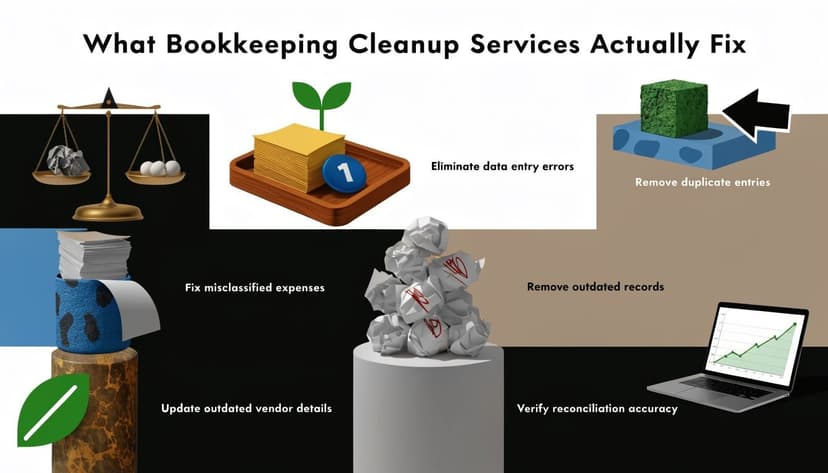
I describe it as financial archaeology. You dig through layers of entries, old rules, imports, missing support, and duplicate transactions to work out what really happened. The software file tells one story. The bank statements, card statements, payroll reports, and invoices often tell another.
The problems that show up most often
The first place I look is reconciliation. A primary reason for cleanup is mismatched bank balances, a problem that affects over 70% of businesses with disorganized books, making reconciliation the top priority, according to Polaris Tax and Accounting.
From there, the issues usually fall into a few buckets:
- Unreconciled bank and credit card accounts. Transactions are missing, duplicated, or posted to the wrong period.
- Misclassified expenses. Meals get coded as supplies, owner draws get buried in expenses, sales tax lands in the wrong account, payroll entries are incomplete.
- Duplicate and missing entries. Imports, bank feeds, and manual data entry often create both at once.
- A cluttered chart of accounts. Too many accounts, vague account names, or overlapping categories make reports hard to read.
- Opening balance problems. Old errors roll forward and distort every report after them.
- Broken automation rules. Rules meant to save time start coding transactions incorrectly at scale.
When these pile up, every report downstream gets shaky. Profit can look stronger or weaker than reality. Liabilities can disappear. Cash can appear available when it isn’t.
A clear explanation of the mechanics helps before the fixing starts. This short walkthrough on bank statement reconciliation is useful because it shows why matching the books to the statements is the backbone of any cleanup.
What a real cleanup changes
A proper cleanup doesn’t just “tidy” the file. It restores usable outputs. That means a balance sheet you can explain, a Profit & Loss report you can defend, and general ledger detail that doesn’t collapse under basic review.
Here’s a practical primer worth watching before you hire or attempt the work yourself:
The goal isn’t a prettier dashboard. The goal is a file that survives scrutiny from your CPA, lender, tax preparer, and your own common sense.
That’s the difference between routine bookkeeping and cleanup. Routine bookkeeping keeps a clean system current. Cleanup repairs a damaged one.
The 5-Stage Bookkeeping Cleanup Process
Cleanup works best when it’s run like a project, not a panic response. The files may be messy, but the process shouldn’t be.
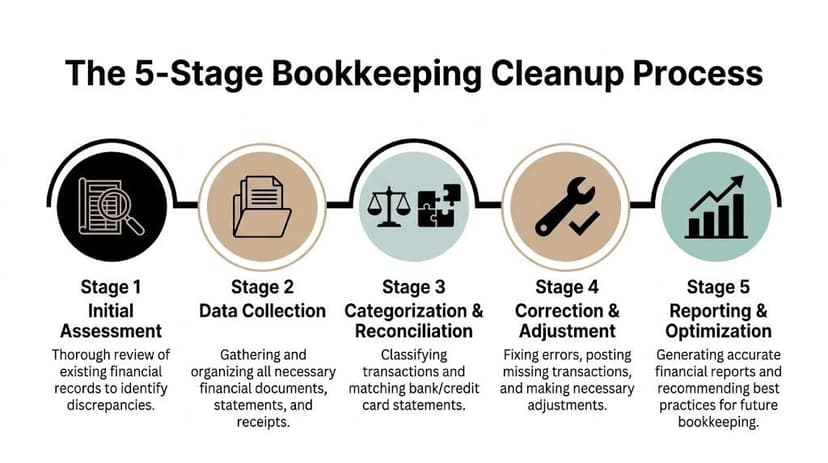
Disorganized accounting files often contain 30% to 70% uncategorized or mismatched entries, according to NorthStar Bookkeeping. That’s why strong cleanup work follows a sequence. If you skip the sequence, you waste time fixing symptoms instead of causes.
Stage 1 Initial assessment
The first step is diagnosis. I review the accounting file, scan the chart of accounts, compare book balances to statement balances, and identify where the file broke down.
The scope of the cleanup is established. Are we correcting one quarter or several years? Are the issues mostly categorization, or are there structural problems like broken opening balances and old unreconciled periods? A cleanup without scoping turns into endless drift.
A good specialist also decides what not to touch yet. Current operations should keep moving while historical periods are repaired in a controlled way.
Stage 2 Data collection
This stage is usually where projects bog down. Owners have partial bank statements, scattered receipts, and missing card records. The cleaner the source documents, the faster the fix.
Typical collection includes:
- Bank and card statements for every affected month
- Loan records so liabilities and interest can be posted correctly
- Payroll reports to verify wages, taxes, and employer costs
- Sales tax records where applicable
- Prior returns or financial statements to anchor beginning balances
This is also where automation matters. Instead of retyping statement data line by line, firms increasingly use automated data entry software to extract and structure transactions before reconciliation starts.
Stage 3 Categorization and reconciliation
This is the heavy lift. Each transaction gets reviewed, coded correctly, and tied back to source statements. Bank and credit card accounts are reconciled month by month. Duplicates are removed. Missing items are added. Old miscategorizations are reclassed.
In practice, this stage often uncovers patterns, not isolated errors. One bad rule may have misposted months of transactions. One incorrect opening balance may have distorted every reconciliation after it.
Stage 4 Correction and adjustment
Once the books tie to the source documents, adjusting entries clean up the remaining distortion. That may include journal entries for payroll, loans, owner transactions, sales tax, fixed assets, or prior period corrections.
This stage requires judgment. Not every discrepancy deserves a heroic reconstruction. Sometimes the right answer is a documented adjustment based on the best available records. Good cleanup work balances accuracy with auditability.
Field note: If you can’t explain an adjustment in one plain sentence, it probably isn’t ready to post.
Stage 5 Reporting and handoff
The final deliverable isn’t “the file is better now.” It’s a set of reliable reports and a handoff plan. That usually includes an updated Profit & Loss, balance sheet, general ledger, and notes on what changed.
The smartest handoffs also include process repairs, such as:
- Monthly reconciliations with a fixed schedule.
- Simpler account structures so coding decisions are clearer.
- Tighter document collection for statements and receipts.
- Reviewed automation rules so the same errors don’t return.
That’s what makes cleanup stick. Without that last step, many businesses tend to recreate the same mess in a cleaner file.
DIY Cleanup vs Hiring a Professional
Some cleanups are realistic DIY projects. Others are traps that eat weekends and still end with unreliable numbers. The right choice depends less on motivation and more on complexity, software fluency, and what your time is worth.
When DIY can work
DIY cleanup is reasonable when the backlog is short, the business is simple, and the owner already understands the accounting software. If you know how reconciliations work, can trace transactions back to statements, and can spot misclassifications without guessing, you can often repair a limited mess yourself.
It also helps if the records are mostly complete. Missing statements and unclear owner transactions are what turn “I’ll do it myself” into a drawn-out forensic exercise.
When a professional is the safer call
Once the file includes multiple accounts, older unreconciled periods, payroll problems, loan balances, or tax-sensitive errors, professional cleanup usually pays for itself. The biggest hidden cost in DIY isn’t software. It’s wrong corrections.
A common example is using invoice and receipt extraction tools well for documents, but then struggling with account-level cleanup logic. Tools like OCR software for invoices help collect evidence, but they don’t replace accounting judgment when balances don’t tie or historical entries are wrong.
Here’s the side-by-side view I give clients.
| Factor | DIY Cleanup | Professional Service |
|---|---|---|
| Cost | Lower cash outlay at first | Higher upfront spend, but clearer scope |
| Time | High owner time commitment | Lower owner time after document handoff |
| Accuracy | Depends on bookkeeping skill and patience | Stronger if the specialist understands reconciliations, reclasses, and historical corrections |
| Stress | Usually high when problems compound | Usually lower because someone owns the process |
| Best fit | Short backlog, simple books, good records | Older messes, multiple accounts, tax prep, lender review, or unclear balances |
If the books affect a tax filing, financing request, or major decision, “good enough” usually isn’t good enough.
There’s also an opportunity cost most owners underestimate. While they’re trying to decode old entries, they aren’t selling, managing staff, or following up with customers. The cleanup becomes a side job they’re not trained for.
That said, hiring a professional doesn’t mean handing over the file and disappearing. The best results come when the owner stays available for questions, missing documents, and business context. A specialist can clean the books. Only the owner can explain why that large transfer happened three months ago.
Bookkeeping Cleanup Pricing and Timelines
A cleanup quote can swing from a few hundred dollars to several thousand for one simple reason. "Twelve months behind" tells me almost nothing until I see the statements, the reconciliations, and the kind of errors sitting in the file.

I have seen two businesses with the same backlog length land in very different ranges. One had clean bank statements, one credit card, and a handful of miscategorizations. The other had Shopify deposits, payroll adjustments, owner draws posted as expenses, and unreconciled transfers bouncing between accounts. Same months. Very different job.
Most firms price cleanup work one of two ways. Hourly billing fits projects with missing records or unclear scope. Fixed-fee pricing works better after a review of the bank activity, account list, transaction volume, and likely correction work. If a provider gives a firm quote without asking for statements or access, assume that number will change later.
Market guides on how much bookkeeping costs can help frame the baseline, but cleanup work is its own category. Ongoing monthly bookkeeping records the present. Cleanup is financial archaeology. You are reconstructing what happened, proving it with source documents, and correcting the ripple effects that bad entries created.
What actually drives the price
These factors usually decide whether a project stays manageable or turns expensive:
- Backlog length. More months usually means more reconciliations and more historical errors to trace.
- Transaction volume. A service business with 80 transactions a month is cheaper to clean than a retail or ecommerce file with hundreds.
- Number of accounts and systems. Every bank account, card, loan, payroll platform, and payment processor adds work.
- Record quality. Clean statements and organized support reduce labor. Missing months and partial exports increase it.
- Type of correction. Recoding expenses is faster than fixing duplicated income, broken opening balances, or unreconciled transfers.
- Response time. If the owner takes ten days to answer questions about a large withdrawal or missing deposit, the project pauses.
One cost lever gets overlooked. Document preparation.
When clients send clean PDF statements, CSV exports, and complete account access on day one, cleanup moves faster. When statements arrive as scans, screenshots, or mixed formats, labor hours climb before any accounting judgment starts. That is where modern AI tools can change the economics. Bank statement converters can pull transaction data from PDF statements into spreadsheet-ready formats much faster than manual entry, which cuts prep time and lowers the amount of paid cleanup labor spent on clerical work. They do not replace reconciliation work or accounting review, but they can remove a lot of expensive hand-keying from the project.
That speed gain affects ROI in a very practical way. Fewer hours spent turning statements into usable data means more of the budget goes to actual cleanup: reconciliations, reclasses, loan balancing, and finding the entries that are distorting your reports.
How long cleanup usually takes
Timelines depend less on the calendar and more on friction. A short backlog with complete records can be cleaned in days. A multi-year file with missing statements, payroll problems, or unclear owner transactions can stretch for weeks.
The bottlenecks are predictable:
- waiting for statements or login access
- untangling transfers between accounts
- tracing payment processor deposits
- correcting prior-period reconciliations
- getting answers on unusual transactions
I tell clients to expect a two-part timeline. First comes intake and file review. Then comes the correction work. If the records are organized and the data can be converted quickly from statements into usable transaction files, the first phase shrinks. That can materially reduce both turnaround time and cost. If the source records are incomplete, no software fixes that problem. Someone still has to hunt down evidence and make judgment calls based on what is available.
Good cleanup work is rarely the cheapest quote or the fastest promise. It is the project scoped well enough that you know what will be fixed, what it will likely cost, and what could still slow it down.
How to Select and Vet a Cleanup Specialist
Not every bookkeeper who offers cleanup should be doing cleanup. Ongoing monthly bookkeeping and corrective historical work overlap, but they aren’t the same skill set.
What to look for first
The right specialist should be able to explain their process clearly, identify likely problem areas early, and tell you what documents they need before they quote. Credentials can help, especially if they’re experienced with QuickBooks, Xero, or your specific stack, but process matters more than badges alone.
Look for signs of practical control:
- Clear scoping. They define the periods, accounts, and outputs included.
- Software fluency. They know the difference between fixing a transaction and masking a problem with a journal entry.
- Comfort with messy records. They can explain how they handle missing support and unclear owner transactions.
- Documented handoff. They don’t stop at “all cleaned up.” They show what changed and what happens next.
Red flags that usually show up early
I get wary when a provider promises a fast cleanup without seeing statements or asks no questions about payroll, loans, or prior reconciliations. I’m also cautious when pricing is framed as “affordable” but no one can explain what’s included.
Other warning signs include:
- Vague deliverables. If they can’t name the reports you’ll receive, pause.
- No discussion of prior periods. Historical errors often roll forward.
- No reconciliation-first mindset. If they start with cosmetic recategorization, that’s backwards.
- No audit trail. You want notes, not mystery corrections.
Ask one simple question: “If a CPA or lender questions these numbers later, how will you show what was changed and why?”
Questions worth asking in the interview
Skip generic questions like “Are you experienced?” Ask questions that reveal how they think.
- How do you scope a cleanup when records are incomplete?
- What’s the first account you review and why?
- How do you handle missing bank statements or unclear transfers?
- When do you reclassify transactions, and when do you post adjusting entries instead?
- What reports will I receive at the end?
- How do you prevent the same problems from coming back next month?
- What tools do you use for statement extraction, reconciliation support, and review?
A real cleanup specialist won’t treat those as difficult questions. They’ll answer them comfortably because this is the actual work.
Measuring the ROI of a Bookkeeping Cleanup
Owners often look at cleanup as a painful expense. That’s understandable. But once the books are usable again, the decision looks more like an investment than a repair bill.

The hard-dollar case is already strong. Outsourced cleanup services can yield 300% ROI or more, primarily by avoiding tax penalties, which affect 25% of businesses with messy books, according to Virtual Bookkeeping.
Where the return actually shows up
The return usually appears in three places.
- Penalty avoidance and cleaner tax prep. Bad books cost money when filings rely on them.
- Owner time recovered. Cleanup removes hours of manual statement wrangling and transaction chasing.
- Better decisions. Reliable books support pricing, hiring, cash planning, and funding conversations.
The technology angle matters more now than most guides admit. AI-powered statement extraction and validation reduce the most labor-heavy part of cleanup, which is getting transaction data out of messy PDFs and into a usable structure. Tools in this category can cut costs substantially compared with all-manual processing, especially when the file includes many statements or awkward formats.
One practical example is ConvertBankToExcel, which converts bank and credit card statements into structured files for Excel and accounting workflows, supports 2,000+ banks worldwide, delivers 99%+ CPA-verified accuracy, and can save teams 12+ hours per week according to the publisher information provided for this article. That doesn’t replace bookkeeping judgment. It removes manual extraction bottlenecks so the specialist can spend more time on actual cleanup decisions.
For owners comparing providers, it also helps to understand the broader market for finding affordable bookkeeping services, especially if you’re weighing one-time cleanup against ongoing monthly support after the repair.
Reliable books also sharpen everyday management. Once the cleanup is done, metrics like incremental cash flow become more useful because they’re built on financial data you can finally trust.
Cleanup pays off when it restores confidence, shortens admin time, and keeps bad numbers from driving expensive decisions.
If you’re cleaning up months or years of bank and credit card activity, ConvertBankToExcel can help with the most tedious part of the job: turning PDF statements into structured data for reconciliation and reporting. It’s built for bookkeepers, CPAs, and finance teams who need faster extraction from messy statement files before cleanup work begins.