
Ever had that sinking feeling when you realize your company paid a $50,000 invoice for goods that never even showed up? It's an accounts payable nightmare, and it happens way more often than you'd think.
This is where three-way matching comes in. It's the single most important financial gut check you can implement to stop these costly mistakes before they happen.
Your Definitive Guide to Three Way Matching
Think of three-way matching as your company's own internal fraud detector. It’s a simple but powerful process that confirms every payment is legit before a single dollar leaves your bank account.
At its core, the process confirms that what your company ordered, what it received, and what it was billed for all line up perfectly. Without this check, you’re basically flying blind, leaving your business exposed to overpayments, paying for the same invoice twice, and even straight-up fraud.
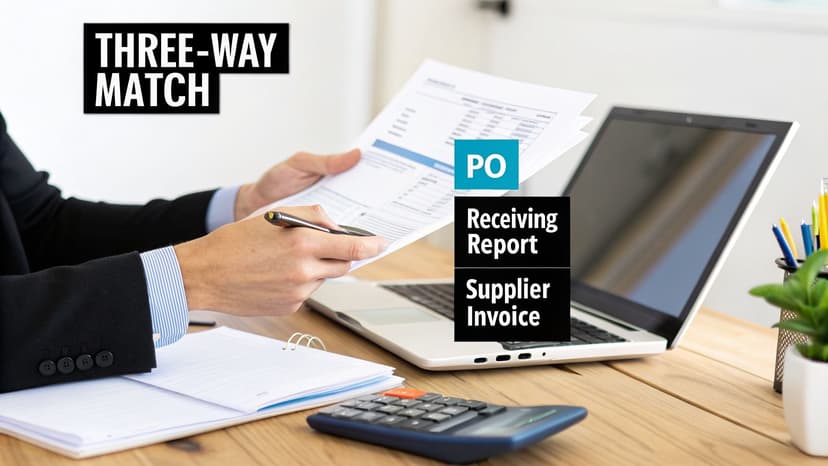
This control is the bedrock of any healthy accounts payable department. To see how it fits into the bigger picture, this Account Payable Workflow Ultimate Guide breaks down the entire process from start to finish.
The Three Pillars of the Process
The whole system hangs on three critical documents. Each one provides a piece of the puzzle, and a payment should only be approved when all three pieces fit together seamlessly.
Here’s a breakdown of the three documents and what your team should be looking for in each one.
The Three Pillars of Three Way Matching
| Document | Purpose | Key Details to Verify |
|---|---|---|
| Purchase Order (PO) | This is the intent to buy. It's the official order your company issues to a vendor. | Item numbers, quantities, agreed-upon price, delivery terms. |
| Receiving Report | This is the proof of delivery. Your warehouse or receiving team creates it when the goods arrive. | What was actually delivered, the quantity received, and the condition of the items. |
| Supplier Invoice | This is the request for payment. It's the bill the vendor sends you. | Invoice number, PO number reference, item quantities, prices, and payment terms. |
By locking these three documents together, your AP team can spot problems before they turn into losses.
A mismatch might be a simple typo on the invoice, or it could be a major red flag, like being billed for 100 units when only 80 arrived.
The impact is huge. Industry reports show that companies using three-way matching can slash payment errors by up to 80%. When you consider that some studies find 1 in 5 invoices has some kind of error, you can see why this isn't just a "nice-to-have" process—it's essential for protecting your bottom line.
Decoding the Three Core Documents of AP
To get what three-way matching is all about, you need to know the three documents that make it tick. Each one is a separate checkpoint. Together, they form a powerful security system for your company’s cash.
The whole process boils down to a simple idea: you only pay for what you ordered and what you actually received. Let’s break down each document and the critical role it plays.
The Purchase Order (PO): Your Official Intent to Buy
First up is the Purchase Order (PO). This is your company's official, legally binding commitment to a vendor. Think of it as creating a detailed shopping list before you even head to the store, locking in exactly what you need and what you’ve agreed to pay.
Your procurement or purchasing department creates the PO and sends it to the vendor before any goods are shipped. It’s what locks in the terms of the deal.
Key details to verify on a PO include:
- Specific item descriptions and SKU numbers
- Agreed-upon quantities for each item
- The unit price and total cost
- Payment terms and expected delivery date
Without a PO, a purchase is just an informal request, leaving you wide open to price hikes and arguments over quantity later on. It’s the foundational document that sets clear expectations from the very start.
The Goods Receipt Note (GRN): Proof of Delivery
Next, the delivery truck arrives. This is where the Goods Receipt Note (GRN), sometimes called a receiving report, comes in. If the PO was your shopping list, the GRN is you checking your bags after leaving the store to make sure you got everything.
Your warehouse or receiving team creates this internal document when the physical goods show up. It’s the impartial proof of what was delivered, how much of it there was, and the condition it arrived in. It’s not about what the vendor claims they sent; it’s about what your team physically counted and inspected.
The Supplier Invoice: The Request for Payment
The final piece of the puzzle is the Supplier's Invoice. This is the bill—the vendor's formal request to get paid. The invoice should always reference the original PO number and spell out what the vendor is charging you for.
This is where the real matching happens. Your accounts payable team takes this invoice and holds it up against the PO and the GRN. Do the prices on the invoice match the prices on the PO? Do the quantities billed match the quantities your team counted on the GRN?
Any discrepancy—a sudden price hike, a bill for items that never showed up—immediately flags the invoice for investigation. This simple verification step is quickly becoming a non-negotiable standard for a reason.
Recent global surveys back this up, showing that 68% of finance teams now mandate three-way matching for significant orders, a sharp increase driven by shaky supply chains. But doing this check manually can take an AP clerk 15-20 minutes per invoice, creating huge bottlenecks for any business trying to grow. You can discover more insights about this shift in the full AP automation report from Sage.
The Three Way Matching Process Step by Step
Knowing the three documents is one thing. Seeing how they work together to stop a bad payment in its tracks is another.
Let's walk through how this actually plays out on the ground. We’ll follow a fictional manufacturing firm, "Innovate Makers," as they order raw materials for their next production run.
This whole process kicks off long before an invoice ever hits the AP team's inbox. It starts with a purchase.
Step 1: Issue the Purchase Order
It all begins in the procurement department. A manager at Innovate Makers sees they're running low on a key component and need 500 units of high-grade steel.
They generate a formal Purchase Order (PO). This isn't just an email; it's a contract. It spells out the exact item number, a description of the steel, a quantity of 500 units, and the agreed-upon price of $10 per unit. The total comes to $5,000.
That PO goes over to their supplier, "SteelCorp," who accepts the terms. This document is now the source of truth for the purchase—the first pillar of our three-way match.
Step 2: Receive and Document the Goods
A week later, a SteelCorp delivery truck pulls up to the Innovate Makers warehouse. The receiving team doesn't just sign a clipboard and wave the driver off. They have a job to do.
They pull out the PO and start inspecting the shipment. They count the steel units one by one and check for any damage. Everything looks good. They confirm exactly 500 units arrived in perfect condition.
A team member creates a Goods Receipt Note (GRN), documenting the delivery of 500 units. This isn't just paperwork; it’s the second pillar—an independent confirmation of what the company physically has in its possession.
Step 3: Match the Invoice and Approve
Finally, SteelCorp’s invoice lands in the accounts payable department. Now the AP clerk has all three pieces of the puzzle and can perform the actual three-way match.
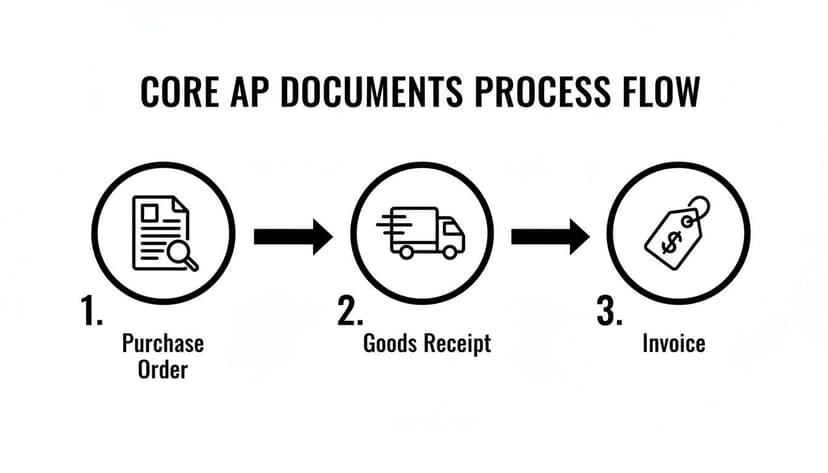
As you can see, the process acts like a funnel. Each document has to line up perfectly before a payment gets the green light.
The AP clerk gets to work, comparing the key details:
- PO vs. Invoice: The PO authorized a purchase of 500 units at $10 each, for $5,000. The invoice is for 500 units at $10 each, for $5,000. That’s a perfect match.
- GRN vs. Invoice: The GRN confirms 500 units were received. The invoice is billing for 500 units. Another perfect match.
Because all three documents tell the same story, the invoice is approved for payment. But what happens if the numbers are off?
Most businesses set 'tolerances'—small, acceptable variances in price or quantity. For instance, a company might accept a 1% price difference or a 2% quantity variance to avoid halting payments over minor discrepancies.
If SteelCorp's invoice had been for 505 units, it would have been flagged as an exception. The payment would be put on hold, and someone would have to investigate why the invoice doesn't match what was ordered and received.
This structured workflow is the bedrock of financial control. But as you can imagine, manually checking every line item on every invoice is a massive time sink. This is why many growing firms now use automated data entry software to handle the matching instantly, freeing up their AP teams to focus only on the exceptions that actually need a human eye.
Unlocking the Business Benefits of Three-Way Matching
Putting a solid three-way matching process in place is so much more than just a defensive move against paying a bad invoice. Think of it as a strategic upgrade that pays dividends across your entire company, tightening up your financials and making operations smoother. While catching fraud is a huge win, the real value is in all the positive side effects.
The most immediate payoff? You get an ironclad audit trail. Every payment is clearly tied back to what was ordered and what was received. When auditors show up, you're not scrambling to find paperwork. Instead, it's a calm, organized review that builds real confidence with auditors, investors, and anyone else looking at your books.
Build Stronger Supplier Relationships
Let’s be honest, invoice disputes are a major source of friction with suppliers. When you constantly delay payments because of discrepancies, trust breaks down. Before you know it, you’re in an adversarial relationship, not a partnership.
Three-way matching completely changes that dynamic.
By catching and fixing issues before the invoice even gets approved, you make sure suppliers are paid correctly and on time. That kind of reliability makes you a customer they want to work with. It opens the door to better payment terms, priority service, and a much more collaborative relationship.
Boost Your Financial Credibility and Access to Capital
If you're trying to get a business loan or pitch to investors, messy financial records are a deal-breaker. Inaccurate data is a huge red flag that can kill your credibility fast. A well-run three-way matching process keeps your accounts payable records spotless, giving a true picture of what your company owes.
For founders and anyone applying for a loan, clean AP records are an absolute asset. They are the foundation of accurate financial statements, which directly impacts your ability to get funded.
This isn't just theory. Three-way matching drastically cuts down on manual errors and is a powerful fraud deterrent. In fact, some studies show it can slash duplicate payments by up to 90%—a problem that costs businesses billions. Beyond just stopping bad payments, implementing this control is a key part of improving your Accounts Payable process. The data shows clean financials can even lower loan rejection rates. You can read more about how three-way matching benefits your AP process on REPAY.
Ultimately, the benefits ripple out far beyond the AP department. When you lock down this core financial control, you get:
- Reduced Costs: You stop overpaying, kill duplicate payments, and cut the hours your team spends chasing down and fixing mistakes.
- Improved Cash Flow Management: With a crystal-clear view of your liabilities, you can forecast your cash needs with much greater accuracy.
- Tighter Internal Controls: It builds a culture of precision and accountability from the moment an order is placed to the moment the payment goes out.
What looks like a simple verification step is actually a foundational practice that strengthens your company's financial health, improves key partnerships, and sets you up for real, sustainable growth.
Handling Mismatches and Exceptions Like a Pro
Sooner or later, it happens. An invoice lands on your desk, and the numbers just don't add up. The quantity is wrong, the price is higher than you agreed to, or the receiving team says half the shipment was damaged. In a perfect world, every document would line up flawlessly. But in the real world of accounts payable, exceptions are just part of the job.
The difference between a smooth AP process and a chaotic one is how your team handles these mismatches.

When a discrepancy pops up, the very first step is simple: put the invoice on hold. Never approve a payment with an unresolved exception. This is your single most important control to prevent overpayments and protect your company’s cash while you get to the bottom of the issue. A structured response is key; panic is not.
Your team’s next move is to figure out what went wrong. Was it a simple typo during data entry? Or does this mismatch point to a bigger problem with a supplier or a flaw in your own procurement process?
The Usual Suspects: Common Discrepancies
Most mismatches aren't exotic mysteries. They usually fall into one of a few common buckets. Knowing what to look for helps you trace the problem back to its source much faster.
Here are the culprits we see most often:
- Price Mismatches: The price on the invoice is different from the price on the purchase order. This can happen if a supplier quietly raised their prices without updating your procurement team, or it could just be an error on their end.
- Quantity Mismatches: The invoice bills for 100 units, but the goods receipt note from the warehouse only shows 95. This is a classic sign of a partial shipment, a backorder, or sometimes just a counting error.
- Damaged or Incorrect Goods: The warehouse team signed for a delivery, but the items they received were the wrong product entirely or arrived in poor condition. The quantity might match on paper, but the quality certainly doesn't.
Each of these problems has a different fix. A price issue usually means a call to the supplier, and maybe a quick check-in with the procurement manager who negotiated the original PO. A quantity problem, on the other hand, always starts with the warehouse or receiving team to confirm their physical count.
The goal of handling an exception isn't to play the blame game. It’s about fixing the immediate problem, getting the invoice paid correctly, and documenting everything. A clear communication trail is your best friend during an audit and for managing long-term supplier relationships.
For example, if one supplier constantly sends invoices with the wrong pricing, tracking those exceptions gives you hard data. You can then go back to them and say, "We've had to correct your last four invoices. Let's figure out what's going on."
Effectively managing these issues is a core part of AP. If your team is constantly bogged down by mismatches, you might find our guide on solving reconciliation mismatches helpful.
A Practical Table for Troubleshooting
Chasing down exceptions can feel like chaos. To bring some order to the process, it helps to have a simple playbook. The table below outlines the most common discrepancies and the first steps to take, turning a confusing problem into a clear action plan.
Common Matching Discrepancies and How to Resolve Them
| Discrepancy Type | Potential Cause | Resolution Steps |
|---|---|---|
| Price Variation | Vendor invoicing error, outdated pricing in the PO, uncommunicated price increase. | 1. Contact the supplier immediately for a corrected invoice or credit memo. 2. Internally, notify the procurement team to update their pricing records if needed. |
| Quantity Shortfall/Overage | Partial shipment, backordered items, shipping error, or a miscount by the receiving team. | 1. Contact the warehouse/receiving team to verify their physical count against the packing slip. 2. Check the PO and shipping documents for any notes about a partial shipment or backorder. |
| Damaged or Incorrect Goods | Poor packaging, shipping carrier mishandling, vendor fulfillment error. | 1. Ask the receiving team for photos to document the damage or incorrect items. 2. Contact the supplier to request a return authorization, credit, or replacement shipment. |
| Duplicate Invoice | Vendor accidentally resent an invoice, or an internal error created a duplicate entry. | 1. Check your AP system for the original invoice number to confirm it has already been processed or paid. 2. Notify the vendor that you received a duplicate and will not be processing it. |
| Sales Tax/Freight Charges | Charges were included on the invoice but not listed on the PO. | 1. Review the original PO terms. If these charges are not allowed, contact the supplier for a revised invoice. 2. If the charges are valid but were missed, update the PO to reflect the total cost. |
By using a structured approach like this, your team can resolve exceptions far more quickly. It keeps the payment process moving, ensures you only pay what you owe, and maintains the strong financial controls your business relies on.
How Automation Can Streamline Your Matching Process
Manually matching hundreds of invoices, line by line, is a classic recipe for team burnout and expensive mistakes. While it's a critical control, the old way of doing three-way matching is just too slow and tedious. It creates bottlenecks that frustrate everyone and can even damage relationships with good suppliers.
But that whole manual grind is changing. AP automation software acts like a hyper-efficient assistant for your finance team, doing all the heavy lifting of document comparison in seconds, not hours.
This isn’t about replacing people. It's about getting your team out of the weeds of mind-numbing data entry so they can focus on high-value work. By taking manual tasks off their plate, you give them the time—and the clean data—they need for financial analysis, cash flow forecasting, and intelligently managing exceptions.
How AP Automation Works
Instead of a human staring at three different documents, automation uses artificial intelligence to read, understand, and validate everything instantly. The system takes in the purchase order, the goods receipt, and the supplier invoice, then performs the check on its own.
It boils down to three core steps:
Data Extraction: First, the software uses powerful recognition technology to lift all the key details from each document—PO numbers, item quantities, prices, you name it. If you're curious about how it reads the invoice, you can learn more about how OCR software for invoices works.
Automatic Matching: Next, the AI cross-references all that data. It instantly confirms that the details on the invoice line up perfectly with what was ordered on the PO and what the team confirmed receiving on the GRN.
Exception Flagging: If everything matches, the invoice is automatically routed for approval and payment. No human touch needed. But if there’s any mismatch—even a small one—the system immediately flags it as an exception and sends it to the right person to sort out.
This shift completely flips the script. Instead of your team spending 80% of their time on manual matching and just 20% on fixing problems, automation reverses that ratio.
The result is a system that kills payment delays, gives you a real-time view of your liabilities, and catches errors before they ever hit your books. It frees up your team to provide real strategic value, turning the AP department from a cost center into a hub of financial intelligence.
Frequently Asked Questions About Three Way Matching
When you first start with three-way matching, a few questions always come up. It's a powerful control, but it's not a one-size-fits-all solution. Let's clear the air on the most common queries we see.
Is Three Way Matching Necessary for Every Single Purchase?
Absolutely not. In fact, you’d drive your AP team crazy if you tried.
Applying a three-way match to a $15 office supply order or your monthly software subscription is overkill. For low-value items or predictable recurring payments, a simple two-way match (invoice vs. purchase order) is much more efficient.
The real power of three-way matching shines when you’re dealing with physical goods, expensive orders, or a brand-new supplier. That’s where the risk of getting the wrong quantity—or paying for something that never showed up—is highest. The trick is to match the level of control to the level of risk.
What Is the Difference Between Two Way and Three Way Matching?
It really just boils down to how many documents you’re checking.
- Two-Way Matching: You only compare the purchase order to the supplier’s invoice. Does what they're billing you for match what you agreed to buy?
- Three-Way Matching: You add the goods receipt note into the mix. This is the crucial step that confirms the items physically arrived at your warehouse or office.
Some companies even take it a step further with a four-way match, adding an inspection report to verify the quality of the goods. But for most businesses, the three-way match hits the sweet spot, offering a solid balance of security without grinding your payables process to a halt.
How Can Small Businesses Implement This Without Expensive Software?
You don't need a pricey system to get started. A disciplined manual workflow is a perfectly good first step.
Create a simple purchase order template in Excel or Word. Make it a rule that someone has to sign a delivery confirmation for all incoming shipments. Most importantly, designate one person to perform the actual check—PO vs. receipt vs. invoice—before any payment gets approved.
While basic accounting software can help, a clear, documented process is what truly makes it work. You can always add automation later as you grow.
Ready to stop wasting time on manual data entry and start automating your financial workflows? The AI-powered tools at ConvertBankToExcel transform bank statements into structured data for Excel, QuickBooks, and more in seconds. Get started for free at ConvertBankToExcel.com and see how much time you can save.